3.11 — ℝⁿ-এ Lebesgue Integration
এই অধ্যায়ে কী শিখব: \(\mathbb{R}^n\)-এ Borel ও Lebesgue measure কীভাবে product measure হিসেবে গড়ে ওঠে; \(\mathbb{R}^n\)-এ integration; unit ball \(B_n\)-এর volume-এর বিখ্যাত formula Fubini দিয়ে পেতে শিখব; mixed partial derivatives-এর সমতা Fubini থেকে প্রমাণ করব; এবং Part 3-এর সামগ্রিক চিত্র — Riemann-এর কোথায় সমস্যা ছিল, Lebesgue কীভাবে সব ঠিক করল।
উৎস (source): Lebesgue ও Fubini (ℝⁿ-এ integration)।
১. কেন শিখব? (Motivation)
Part 3-এর শুরুতে (3.1 — Outer Measure) আমরা বেরিয়েছিলাম একটা প্রশ্নের উত্তর খুঁজতে: Riemann integral-এর সীমাবদ্ধতা দূর করা কীভাবে সম্ভব? পুরো Part 3 জুড়ে পেয়েছি:
- Measure theory (3.1–3.5): measurable sets ও Lebesgue measure।
- Lebesgue integral (3.7–3.8): DCT, MCT, Fatou।
- Differentiation (3.9): Lebesgue Differentiation Theorem।
- Product measures (3.10): Tonelli ও Fubini।
এখন শেষ ধাপ: এই সব theory \(\mathbb{R}^n\)-এ একত্রিত করা। \(\mathbb{R}^n\)-এর Lebesgue measure হলো product measure — \(n\)-টা real line-এর Lebesgue measure-এর গুণফল।
এই অধ্যায়ে আমরা দেখব:
- Borel subsets of \(\mathbb{R}^n\) কীভাবে product structure পায়।
- \(\lambda_n = \lambda_{n-1} \times \lambda_1\) দিয়ে inductive definition।
- Unit ball-এর volume — একটা সুন্দর recursive formula।
- Mixed partials-এর equality — Fubini-র একটা elegant application।
- পুরো Part 3-এর recap।
২. মূল ধারণা (Core idea)
\(\mathbb{R}^n\)-কে product হিসেবে দেখা
\(\mathbb{R}^n = \mathbb{R}^{n-1} \times \mathbb{R}\)। এই decomposition বারবার করা যায়:
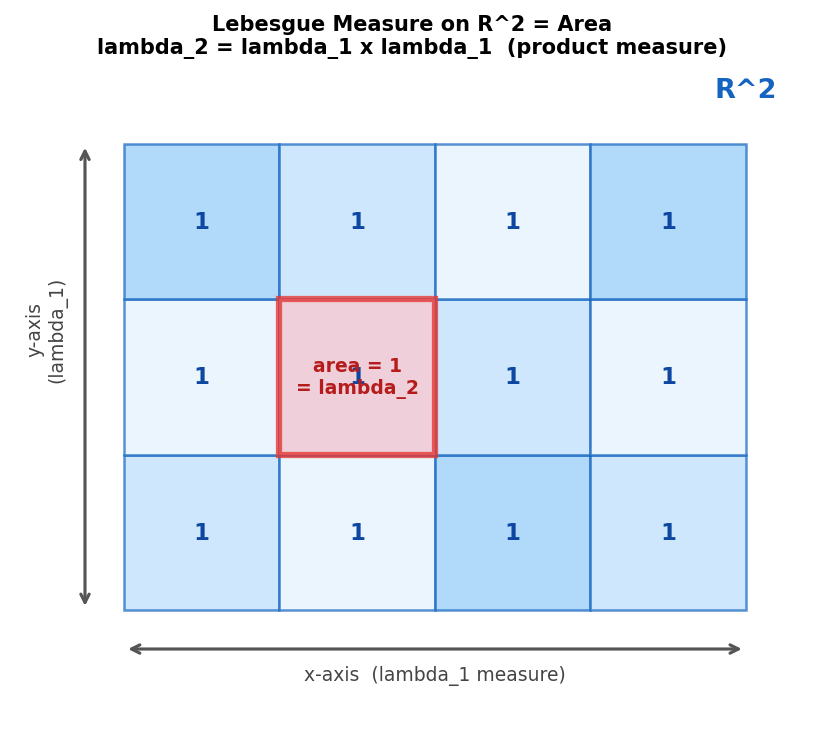 চিত্র: ℝ²-এ Lebesgue measure = area: unit squares-এর grid। lambda_2 = lambda_1 x lambda_1 (product measure)।
তাই স্বাভাবিক: \(\lambda_n = \lambda_1 \times \lambda_1 \times \cdots \times \lambda_1\) (\(n\)-বার)। একটু সাবধানে inductively define করলে এটাই Lebesgue measure on \(\mathbb{R}^n\)।
Unit ball volume-এর স্বজ্ঞা
\(B_n = \{x \in \mathbb{R}^n : \|x\| < 1\}\)। নিচের চিত্রে দেখা যাচ্ছে volume-এর pattern:
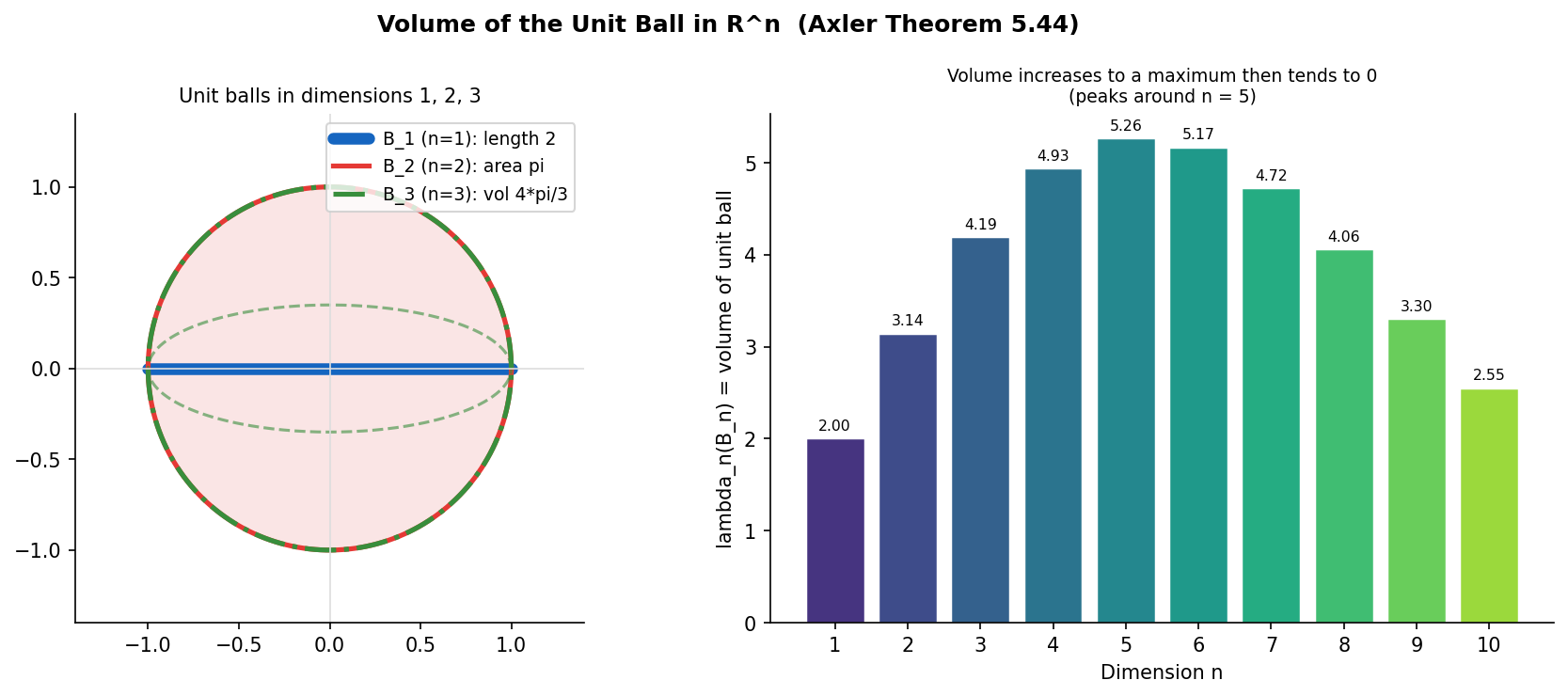 চিত্র ১: বাঁয়ে: \(B_1\) (রেখাখণ্ড), \(B_2\) (বৃত্ত), \(B_3\) (গোলক)। ডানে: \(\lambda_n(B_n)\) বনাম \(n\)। volume \(n=5\) পর্যন্ত বাড়ে, তারপর \(0\)-এর দিকে যায়।
আশ্চর্যের বিষয়: \(n \to \infty\)-তে unit ball-এর volume \(\to 0\)! একটা \(n\)-মাত্রিক unit ball তার circumscribed cube \([-1,1]^n\) (volume \(= 2^n\))-এর ক্রমশ ছোট অংশ হয়ে যায়।
৩. সংজ্ঞা ও উপপাদ্য (Definitions & Theorems)
Borel Sets in \(\mathbb{R}^n\)
সংজ্ঞা
\(\mathbb{R}^n\)-এর Borel subset হলো \(\mathbb{R}^n\)-এর সব open sets ধারণ করা সবচেয়ে ছোট σ-algebra \(\mathcal{B}^n\)-এর elements।
মূল ফলাফল:
মানে: \(\mathbb{R}^m\) ও \(\mathbb{R}^n\)-এর Borel sets-এর product σ-algebra = \(\mathbb{R}^{m+n}\)-এর Borel σ-algebra।
Proof sketch: Open cubes in \(\mathbb{R}^{m+n}\) = products of open cubes in \(\mathbb{R}^m\) ও \(\mathbb{R}^n\)। Open cubes generate \(\mathcal{B}^{m+n}\)। তাই \(\mathcal{B}^{m+n} \subseteq \mathcal{B}^m \otimes \mathcal{B}^n\)। উল্টোটাও একইভাবে। \(\square\)
Lebesgue Measure on \(\mathbb{R}^n\)
সংজ্ঞা
\(\mathbb{R}^n\)-এ Lebesgue measure \(\lambda_n\) inductively define হয়:
\(\lambda_n = \lambda_{n-1} \times \lambda_1,\)
যেখানে \(\lambda_1\) হলো \((\mathbb{R}, \mathcal{B}^1)\)-এর Lebesgue measure। Base case: \(\lambda_1\) = standard।
\(\mathcal{B}^n = \mathcal{B}^{n-1} \otimes \mathcal{B}^1\) (উপরের ফলাফল থেকে), তাই \(\lambda_n\) সত্যিই \(\mathcal{B}^n\)-এ defined।
Integration on \(\mathbb{R}^n\): Tonelli ব্যবহার করে, যেকোনো \(E \in \mathcal{B}^n\)-এর জন্য:
Tonelli-কে বারবার apply করে \(\lambda_n(E)\)-কে \(n\)-টা one-dimensional integral-এর iterated form-এ লেখা যায়।
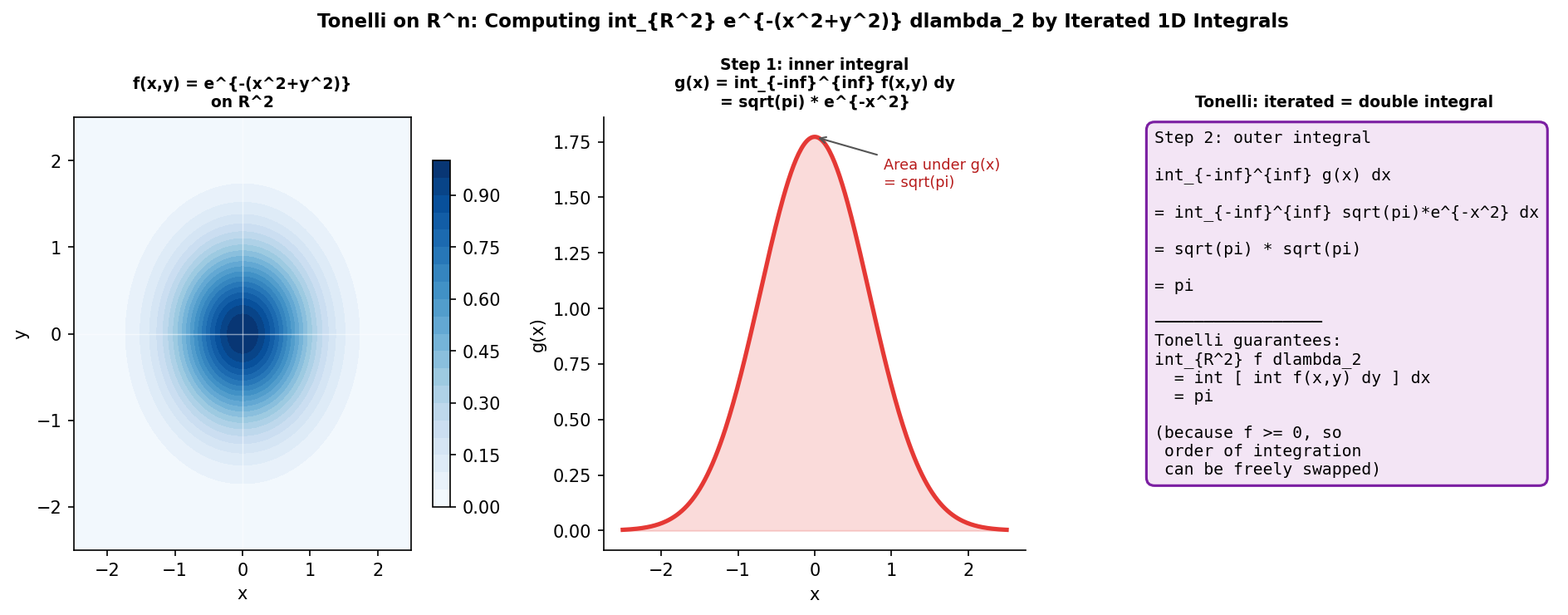 চিত্র: Tonelli on ℝ²: e^{-(x²+y²)} integral step-by-step — double integral = iterated 1D integrals = π।
Translation invariance: \(\lambda_n(a + E) = \lambda_n(E)\) সব \(a \in \mathbb{R}^n\)-এর জন্য — Lebesgue measure translation-invariant।
Dilation: \(\lambda_n(tE) = t^n \lambda_n(E)\) for \(t > 0\) — natural scaling।
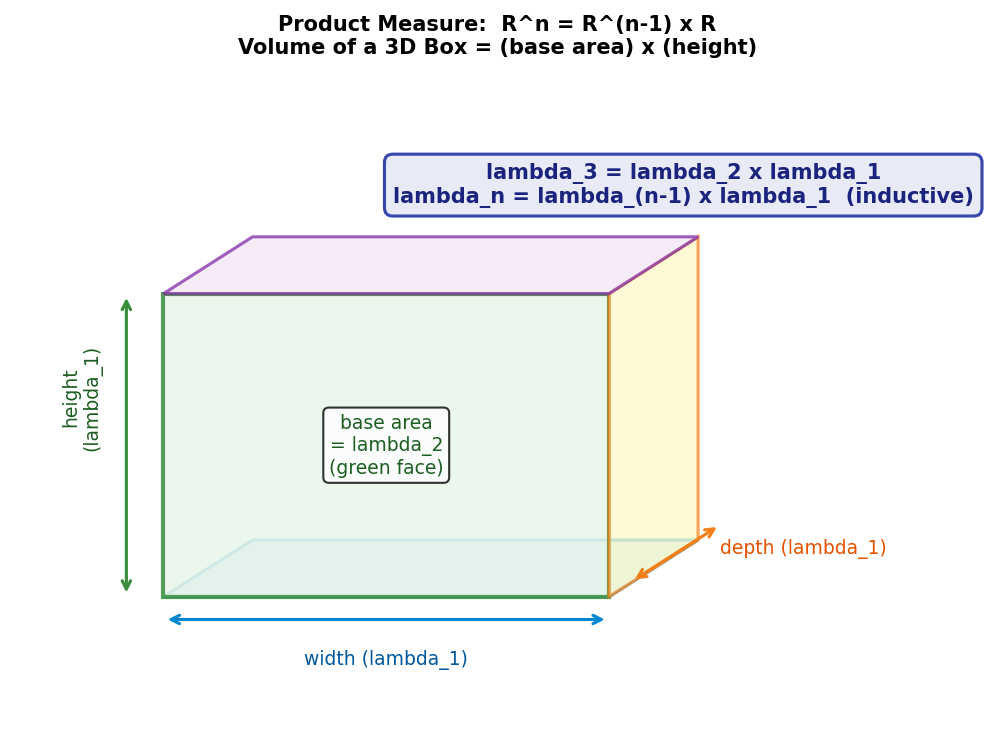 চিত্র: ℝⁿ-এ measure product হিসেবে: 3D box-এর volume = base area × height। lambda_n = lambda_(n-1) × lambda_1।
Volume of the Unit Ball — Worked Computation
এটা।
Theorem: Volume of Unit Ball in \(\mathbb{R}^n\)
প্রথম কয়েকটা মান:
| \(n\) | \(\lambda_n(B_n)\) | আনুমানিক |
|---|---|---|
| 1 | \(2\) | 2.00 |
| 2 | \(\pi\) | 3.14 |
| 3 | \(4\pi/3\) | 4.19 |
| 4 | \(\pi^2/2\) | 4.93 |
| 5 | \(8\pi^2/15\) | 5.26 |
| 6 | \(\pi^3/6\) | 5.17 |
| 10 | \(\pi^5/120\) | 2.55 |
Recursive formula (মূল idea): \(\mathbb{R}^n = \mathbb{R}^2 \times \mathbb{R}^{n-2}\) লিখলে:
Fixed \(x = (x_1, x_2) \in \mathbb{R}^2\): \(\chi_{B_n}(x,y) = 1 \iff \|y\| < (1 - \|x\|^2)^{1/2}\) (যখন \(\|x\| < 1\))।
তাই ভেতরের integral = \(\lambda_{n-2}\!\left((1-\|x\|^2)^{1/2} B_{n-2}\right) = (1-\|x\|^2)^{(n-2)/2}\lambda_{n-2}(B_{n-2})\) (dilation formula)।
তাই:
Polar coordinates (\(d\lambda_2 = r\,dr\,d\theta\)):
Recursive formula: \(\lambda_n(B_n) = \dfrac{2\pi}{n}\lambda_{n-2}(B_{n-2})\), base cases \(\lambda_1(B_1) = 2\), \(\lambda_2(B_2) = \pi\)।
Closed form থেকে: \(\lim_{n\to\infty}\lambda_n(B_n) = 0\)। নিচের exercise-এ এটি prove করবে।
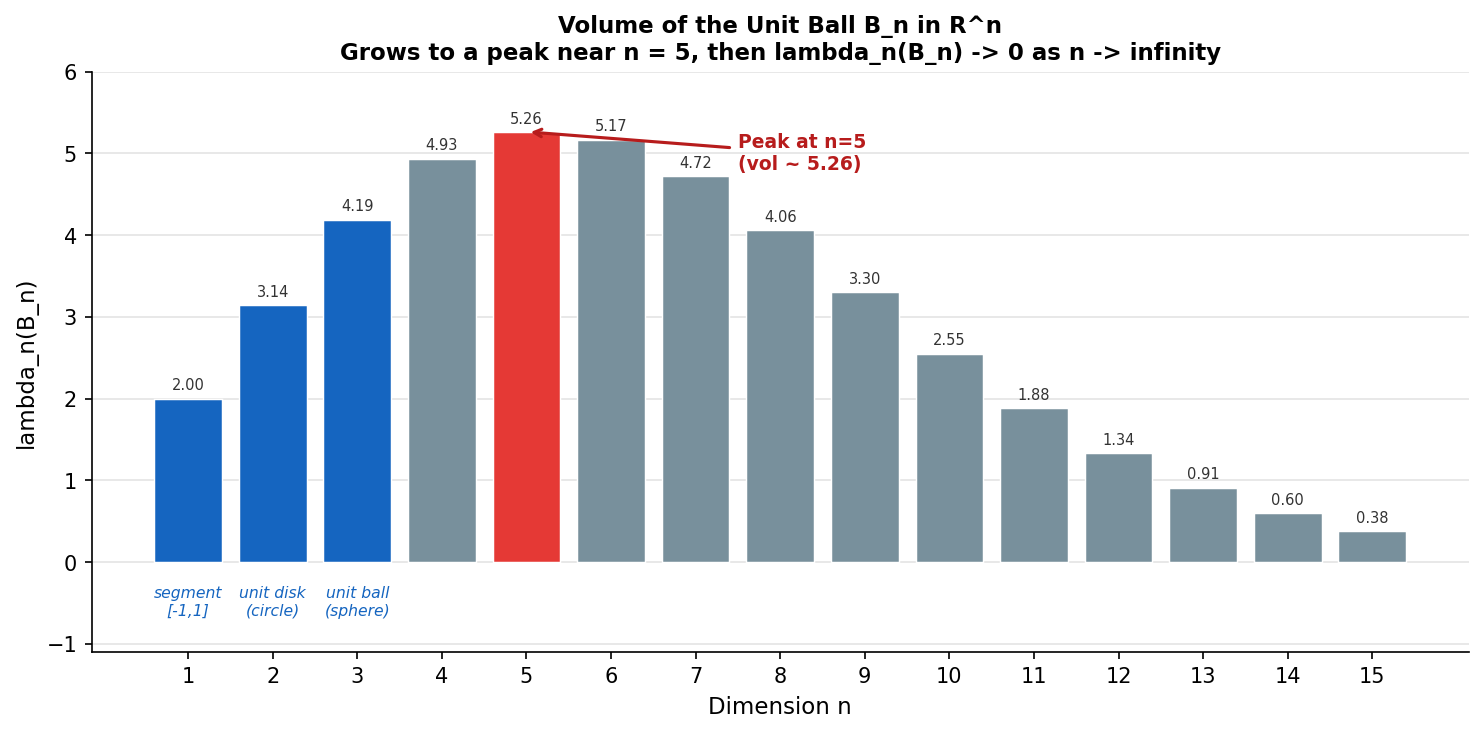 চিত্র: Unit ball-এর volume বনাম dimension n: n=5 পর্যন্ত বাড়ে, তারপর 0-তে যায়।
Equality of Mixed Partial Derivatives via Fubini
Elementary calculus থেকে মনে আছে: বেশিরভাগ ক্ষেত্রে \(\partial_x\partial_y f = \partial_y\partial_x f\)। Fubini এটার একটা clean proof দেয়:
Theorem: Mixed Partial Derivatives
\(G \subseteq \mathbb{R}^2\) open, \(f: G \to \mathbb{R}\)। ধরো \(D_1 f\), \(D_2 f\), \(D_1(D_2 f)\), \(D_2(D_1 f)\) সবই exist ও continuous। তাহলে:
\(D_1(D_2 f) = D_2(D_1 f) \quad \text{on } G.\)
Proof (Fubini-ভিত্তিক): Fix \((a,b) \in G\)। Small square \(S_\delta = [a, a+\delta]\times[b, b+\delta] \subseteq G\) নাও।
Fubini দিয়ে:
একইভাবে \(\int_{S_\delta} D_2(D_1 f)\,d\lambda_2\)-ও একই মান দেয়। তাই:
\(D_1(D_2 f) - D_2(D_1 f)\) continuous এবং সব ছোট rectangle-এ integral 0 → \(D_1(D_2 f) = D_2(D_1 f)\) everywhere। \(\square\)
৪. উদাহরণ ও Analogy
Example 1: \(\lambda_2\) of a Rectangle
\([a_1, b_1] \times [a_2, b_2]\)-এর Lebesgue measure:
সঠিক! Product measure আয়তক্ষেত্রের ক্ষেত্রফল = দৈর্ঘ্য × প্রস্থ দেয়।
Example 2: Unit Ball Volume Verification for \(n=3\)
Recursive formula: \(\lambda_3(B_3) = \frac{2\pi}{3}\lambda_1(B_1) = \frac{2\pi}{3}\cdot 2 = \frac{4\pi}{3}\)। ✓ (elementary formula-র সাথে মেলে!)
Example 3: Integration on \(\mathbb{R}^3\)
\(f(x,y,z) = e^{-(x^2+y^2+z^2)}\) on \(\mathbb{R}^3\)। Tonelli-কে তিনবার apply করলে:
(কারণ integrand \(= g(x)g(y)g(z)\), তাই integral factorizes।)
Analogy: Volume by Slicing
\(\mathbb{R}^3\)-এ একটা region-এর volume মাপতে coordinate direction বরাবর slices নাও। প্রতিটা slice-এর area compute করে সব slices integrate করা—এটাই Fubini/Tonelli-র idea। অন্য direction-এ slice করতে আগে rotation/change-of-variables-এর justification লাগে।
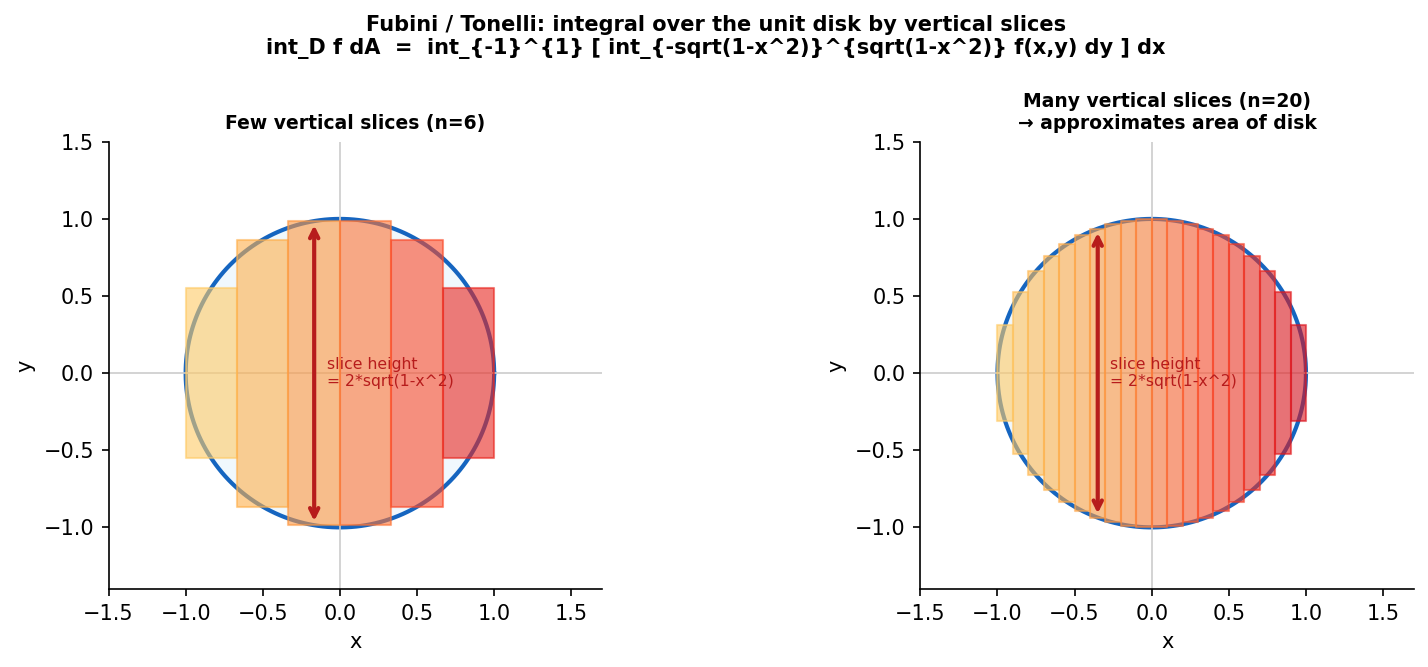 চিত্র: Fubini দিয়ে unit disk-এ integration: vertical slices নিয়ে 2D integral-কে iterated 1D integral-এ রূপান্তর।
৫. সাধারণ ভুল (Common mistakes)
-
\(\mathcal{B}^m \otimes \mathcal{B}^n = \mathcal{B}^{m+n}\) না জানা। এটা trivial নয় — explicitly prove করতে হয়। এছাড়া \(\lambda_{m+n} = \lambda_m \times \lambda_n\) বলার ভিত্তি নেই।
-
Dilation formula ভুল করা। \(\lambda_n(tE) = t^n\lambda_n(E)\) — factor \(t^n\), \(t\) নয়। কারণ \(n\)-মাত্রায় linear scaling \(n\)-ঘাতে volume বাড়ায়।
-
Unit ball volume-কে monotone ভাবা। \(\lambda_n(B_n)\) প্রথমে বাড়ে, তারপর কমে শূন্যে যায়। \(n=5\)-এ সর্বোচ্চ।
-
Mixed partials সবসময় equal ভাবা। continuity ছাড়া হয় না। : \(f(x,y) = xy(x^2-y^2)/(x^2+y^2)\) (\((0,0)\)-তে \(0\)) একটা counterexample।
-
\(\mathbb{R}^n\)-এ integral-কে "just multiply" ভাবা। \(\int_{\mathbb{R}^n} f\,d\lambda_n \neq \prod_{i=1}^n \int_\mathbb{R} f_i\,d\lambda_1\) সাধারণ \(f\)-এর জন্য। এটা শুধু কাজ করে যখন \(f(x_1,\ldots,x_n) = f_1(x_1)\cdots f_n(x_n)\) (separable form)।
৬. এক্সারসাইজ (Exercises)
-
Recursive formula \(\lambda_n(B_n) = \frac{2\pi}{n}\lambda_{n-2}(B_{n-2})\) ব্যবহার করে \(\lambda_4(B_4)\) ও \(\lambda_5(B_5)\) বের করো। উপরের table-এর সাথে মিলিয়ে নাও।
-
\(\lambda_3\)-এ unit sphere \(S^2 = \{x\in\mathbb{R}^3: \|x\|=1\}\)-এর measure কত? কেন?
-
Fubini ব্যবহার করে \(\int_{\mathbb{R}^2} e^{-(x^2+y^2)}\,d\lambda_2\) বের করো। এটা কি \((\int_\mathbb{R} e^{-x^2}\,dx)^2\)-এর সমান? কেন?
-
\(f(x,y) = x^2 + y^2\) on the disk \(D = \{(x,y): x^2+y^2 \leq 1\}\)। Fubini দিয়ে \(\iint_D f\,dA\) বের করো (polar coordinates নয়, সরাসরি)।
-
দেখাও যে \(\mathbb{R}^n\)-এ Lebesgue measure translation-invariant: \(\lambda_n(a+E) = \lambda_n(E)\) সব \(a\in\mathbb{R}^n\), \(E\in\mathcal{B}^n\)-এর জন্য।
-
Mixed partials theorem apply করো \(f(x,y) = x^3y^2 - 2xy^3\)-এর জন্য। \(D_1(D_2 f) = D_2(D_1 f)\) সরাসরি compute করে verify করো।
-
\(\lim_{n\to\infty}\lambda_n(B_n) = 0\) প্রমাণ করো (hint: Stirling's approximation বা recursive formula ব্যবহার করো)।
-
\(f: \mathbb{R}^2 \to \mathbb{R}\), \(f(x,y) = \mathbf{1}_{[0,1]^2}(x,y) \cdot (x-y)\)। \(\int_{\mathbb{R}^2} f\,d\lambda_2\) বের করো। এর জন্য Fubini কি প্রযোজ্য?
৭. সমাধান (ব্যাখ্যাসহ)
১-নং সমাধান দেখাও
Recursive formula: \(\lambda_n(B_n) = \frac{2\pi}{n}\lambda_{n-2}(B_{n-2})\)।
\(\lambda_4(B_4) = \frac{2\pi}{4}\lambda_2(B_2) = \frac{\pi}{2}\cdot\pi = \frac{\pi^2}{2} \approx 4.93\)। ✓
\(\lambda_5(B_5) = \frac{2\pi}{5}\lambda_3(B_3) = \frac{2\pi}{5}\cdot\frac{4\pi}{3} = \frac{8\pi^2}{15} \approx 5.26\)। ✓
২-নং সমাধান দেখাও
\(S^2 = \partial B_3\) হলো একটা 2-dimensional surface \(\mathbb{R}^3\)-এ।
\(S^2=\overline{B_3}\setminus B_3=\{x:\|x\|=1\}\), এবং এর 3D Lebesgue measure \(0\)।
\(\lambda_3\)-measure measure করে 3D volume। \(S^2\) হলো একটা 2D surface, যার 3D "thickness"= 0। তাই \(\lambda_3(S^2) = 0\)।
(আরও সাধারণভাবে, \(k<n\) হলে একটি \(C^1\) embedded \(k\)-dimensional submanifold-এর \(n\)-dimensional Lebesgue measure \(0\)।)
৩-নং সমাধান দেখাও
\(f(x,y) = e^{-(x^2+y^2)} = e^{-x^2}\cdot e^{-y^2}\) — separable।
Tonelli (nonneg):
\(\int_{\mathbb{R}^2} e^{-(x^2+y^2)}\,d\lambda_2 = \int_\mathbb{R}\int_\mathbb{R} e^{-x^2}e^{-y^2}\,dy\,dx = \int_\mathbb{R} e^{-x^2}\left(\int_\mathbb{R} e^{-y^2}\,dy\right)dx.\)
\(\int_\mathbb{R} e^{-y^2}\,dy = \sqrt{\pi}\) (Gaussian integral — এটা polar coordinates দিয়ে যায়, বা পরিচিত result হিসেবে ধরি)।
তাই \(\int_{\mathbb{R}^2} e^{-(x^2+y^2)}\,d\lambda_2 = \sqrt{\pi}\cdot\int_\mathbb{R} e^{-x^2}\,dx = \sqrt{\pi}\cdot\sqrt{\pi} = \pi\)।
হ্যাঁ, এটা \((\int_\mathbb{R} e^{-x^2}\,dx)^2 = (\sqrt{\pi})^2 = \pi\) — সমান। ✓ Separable function-এর জন্য এটাই হয়।
৪-নং সমাধান দেখাও
\(D = \{(x,y): x^2+y^2\leq 1\}\)। Fubini (fix \(x\), integrate \(y\)):
\(\iint_D (x^2+y^2)\,dA = \int_{-1}^1\int_{-\sqrt{1-x^2}}^{\sqrt{1-x^2}}(x^2+y^2)\,dy\,dx.\)
ভেতরের integral:
\(\int_{-\sqrt{1-x^2}}^{\sqrt{1-x^2}}(x^2+y^2)\,dy = 2x^2\sqrt{1-x^2} + \frac{2}{3}(1-x^2)^{3/2}.\)
বাইরের integral (substitution \(x = \sin\theta\)):
\(\int_{-1}^1\left[2x^2\sqrt{1-x^2} + \frac{2}{3}(1-x^2)^{3/2}\right]dx = \frac{\pi}{4} + \frac{\pi}{4} = \frac{\pi}{2}.\)
(প্রতিটা term = \(\pi/4\) — standard trig integrals।)
৫-নং সমাধান দেখাও
Induction on \(n\)। Base case \(n=1\): \(\lambda_1(a + E) = \lambda_1(E)\) — Lebesgue measure translation-invariant (standard result)।
Inductive step: \(a = (a', a_n) \in \mathbb{R}^{n-1}\times\mathbb{R}\)।
\(\lambda_n(a+E) = \int_{\mathbb{R}^{n-1}}\lambda_1([a+E]_x)\,d\lambda_{n-1}(x).\)
\([a+E]_x = a_n + [E]_{x-a'}\)। তাই \(\lambda_1([a+E]_x) = \lambda_1([E]_{x-a'})\) (base case)।
\(= \int_{\mathbb{R}^{n-1}}\lambda_1([E]_{x-a'})\,d\lambda_{n-1}(x) = \int_{\mathbb{R}^{n-1}}\lambda_1([E]_u)\,d\lambda_{n-1}(u) = \lambda_n(E),\)
যেখানে শেষ equality induction hypothesis (\(\lambda_{n-1}\) translation-invariant)। \(\square\)
৬-নং সমাধান দেখাও
\(f(x,y) = x^3y^2 - 2xy^3\)।
\(D_2 f = \partial f/\partial y = 2x^3y - 6xy^2\)। \(D_1(D_2 f) = \partial/\partial x(2x^3y - 6xy^2) = 6x^2y - 6y^2\)।
\(D_1 f = \partial f/\partial x = 3x^2y^2 - 2y^3\)। \(D_2(D_1 f) = \partial/\partial y(3x^2y^2 - 2y^3) = 6x^2y - 6y^2\)।
হ্যাঁ, \(D_1(D_2 f) = D_2(D_1 f) = 6x^2y - 6y^2\)। ✓ (theorem প্রযোজ্য কারণ polynomial — সব partials continuous।)
৭-নং সমাধান দেখাও
Recursive formula: \(\lambda_{2k}(B_{2k}) = \pi^k/k!\)।
Stirling: \(k! \sim \sqrt{2\pi k}(k/e)^k\)।
\(\lambda_{2k}(B_{2k}) = \frac{\pi^k}{k!} \sim \frac{\pi^k}{\sqrt{2\pi k}(k/e)^k} = \frac{1}{\sqrt{2\pi k}}\left(\frac{\pi e}{k}\right)^k \to 0\)
কারণ \((πe/k)^k \to 0\) as \(k\to\infty\) (exponential decay)। ✓
Similarly odd-dimensional case। অথবা recurrence \(\lambda_{n+2}(B_{n+2})=\frac{2\pi}{n+2}\lambda_n(B_n)\) ব্যবহার করে দুই parity subsequence-এর decay দেখানো যায়।
৮-নং সমাধান দেখাও
\(f(x,y) = (x-y)\mathbf{1}_{[0,1]^2}(x,y)\)। Check: \(\int_{[0,1]^2}|f|\,d\lambda_2 = \int_0^1\int_0^1|x-y|\,dy\,dx\)।
\(\int_0^1|x-y|\,dy = x^2/2 + (1-x)^2/2 = x^2 - x + 1/2\)। \(\int_0^1(x^2-x+1/2)\,dx = 1/3 - 1/2 + 1/2 = 1/3 < \infty\)।
হ্যাঁ, \(f \in L^1(\lambda^2)\) — Fubini প্রযোজ্য।
\(\int_{\mathbb{R}^2} f\,d\lambda_2 = \int_0^1\int_0^1(x-y)\,dy\,dx = \int_0^1\left(x - \frac{1}{2}\right)dx = \left[\frac{x^2}{2} - \frac{x}{2}\right]_0^1 = 0.\)
উল্টো ক্রমে: \(\int_0^1\int_0^1(x-y)\,dx\,dy = \int_0^1(1/2-y)\,dy = 0\)। একই! ✓
৮. সারসংক্ষেপ ও Checklist
এই অধ্যায়ের পর নিজেকে যাচাই করো:
- [ ] \(\mathcal{B}^m \otimes \mathcal{B}^n = \mathcal{B}^{m+n}\) — statement ও মূল idea।
- [ ] \(\lambda_n = \lambda_{n-1} \times \lambda_1\) — Lebesgue measure-এর inductive definition।
- [ ] Dilation formula \(\lambda_n(tE) = t^n\lambda_n(E)\) — কেন \(n\)-ঘাত।
- [ ] Unit ball recursive formula \(\lambda_n(B_n) = \frac{2\pi}{n}\lambda_{n-2}(B_{n-2})\) — proof-এর মূল step।
- [ ] Table থেকে জানি: \(\lambda_1(B_1)=2\), \(\lambda_2(B_2)=\pi\), \(\lambda_3(B_3)=4\pi/3\)।
- [ ] \(\lambda_n(B_n) \to 0\) — এই আশ্চর্যজনক ফলাফল বলতে পারি।
- [ ] Mixed partials via Fubini — proof-এর idea।
- [ ] Separable function: \(f(x_1,\ldots,x_n) = f_1(x_1)\cdots f_n(x_n)\) হলে integral factorizes।
এরপর কী? (Part 3-এর সমাপ্তি ও Part 4-এর ভূমিকা)
Part 3-এ আমরা দেখলাম Riemann integral-এর দুটো মূল সীমাবদ্ধতা (মনে আছে 1.7 থেকে?):সমস্যা ১: Dirichlet function Riemann integrable নয়। সমাধান: Lebesgue measure "negligible sets" (measure-zero) ignore করে। Dirichlet function Lebesgue integrable, integral = 0।
সমস্যা ২: Riemann-integrable functions-এর pointwise limit Riemann-integrable নাও হতে পারে। সমাধান: Dominated Convergence Theorem (3.8) — একটি integrable dominator থাকলে Lebesgue integral আর limit আদান-প্রদান করতে পারে।
এছাড়া এই Part-এ পেলাম:
- Egorov, Luzin (3.6): measurable ≈ continuous modulo small sets।
- MCT, Fatou, DCT (3.7–3.8): limit theorems।
- Lebesgue Differentiation (3.9): integral-এর derivative।
- Fubini, Tonelli (3.10–3.11): higher dimensions।
Part 4 (Banach Spaces) কী নিয়ে?
Lebesgue measure আর integration দিয়ে প্রাকৃতিকভাবে জন্ম নেয় কিছু "function space": \(L^1(\mu)\), \(L^2(\mu)\), এবং সাধারণভাবে \(L^p(\mu)\)। এই spaces-গুলো vector space — এবং তাদের উপর একটা " norm"define করা যায়। Norm থাকলে distance-এর ধারণা পাই, আর তার সাথে completeness (যা real line-এর মতো " কোনো gap নেই")।
এই normed complete vector space-গুলোই Banach spaces (ব্যানাখ স্পেস) — Stefan Banach-এর নামে। Part 4-এ আমরা দেখব:
- Normed vector spaces ও Banach spaces।
- \(L^p\) spaces এবং তাদের completeness (Riesz-Fischer theorem)।
- Linear maps (bounded operators) ও functional analysis-এর সূচনা।
- Hahn-Banach, Open Mapping, Uniform Boundedness Principle।
Lebesgue theory না জানলে Banach space বোঝা যায় না — কারণ সবচেয়ে গুরুত্বপূর্ণ Banach spaces হলো \(L^p(\mu)\), যেগুলো Lebesgue integration দিয়ে define।
➡️ পরের অধ্যায়: 4.1 — Normed Vector Space — Part 4 (পরে)।