4.6 — Open Mapping, Closed Graph, Uniform Boundedness
এই অধ্যায়ে কী শিখব: Baire Category Theorem (বেয়ার শ্রেণি উপপাদ্য)-কে ইঞ্জিন হিসেবে ব্যবহার করে Banach space-এর তিনটি মহা-উপপাদ্য — Open Mapping Theorem (খোলা চিত্রণ উপপাদ্য), Closed Graph Theorem (বদ্ধ লেখচিত্র উপপাদ্য), এবং Uniform Boundedness Principle / Banach–Steinhaus theorem — এদের বিবৃতি, স্বজ্ঞা, proof sketch, এবং প্রয়োগ।
উৎস (source): Banach, Steinhaus (uniform boundedness); Baire।
১. কেন শিখব? (Motivation)
৪.৫ অধ্যায়ে Hahn–Banach theorem দেখেছিলাম — সেটা ছিল functional analysis-এর বিস্তার উপপাদ্য। এই অধ্যায়ে আসে তিনটি কাঠামোগত উপপাদ্য, যেগুলো বলে Banach space-এর bounded linear operator (সীমাবদ্ধ রৈখিক অপারেটর)-রা কতটা "ভালো আচরণ" করে।
গল্পটা এক বাক্যে: Baire আমাদের বলে একটা complete space কখনো "ছোট" সেটে ভাগ হয় না। সেই Baire-ই তিনটি শক্তিশালী উপপাদ্যের মূল ইঞ্জিন।
কেন গুরুত্বপূর্ণ?
-
Open Mapping Theorem (Banach–Schauder): Banach space-এর মধ্যে bounded linear \(T:V\to W\) surjective হলে \(T\) open। \(T\) additionally injective হলে inverse \(T^{-1}\) continuous—এটি Bounded Inverse Theorem। PDE-তে theorem stability/continuous dependence establish করতে সাহায্য করে; uniqueness শুধু এটি থেকে আসে না।
-
Closed Graph Theorem: Banach space-এর মধ্যে everywhere-defined linear map-এর graph closed হলে map bounded। Domain/operator assumptions বাদ দিলে statement false হতে পারে।
-
Uniform Boundedness Principle: Banach domain-এ bounded linear operator-family pointwise bounded হলে operator norm uniformly bounded।
মূল স্বজ্ঞা
ভাবো তুমি একটা ঘরের প্রতিটা কোণায় বাতি জ্বালিয়েছ — প্রতিটা কোণ আলোকিত। Baire বলছে: যদি ঘরটা complete (পাকা), তাহলে এই আলোগুলো মিলে পুরো ঘর ঢেকে ফেলতে পারে — uniformly। সেটাই Uniform Boundedness Principle-এর স্বজ্ঞা।
২. মূল ধারণা (Core idea)
Baire — ইঞ্জিন
২.৯ অধ্যায়ে Baire Category Theorem শিখেছিলাম: একটা complete metric space (সম্পূর্ণ মেট্রিক স্থান) কখনো countably many nowhere-dense (কোথাও নিবিড় নয়) সেটের union হতে পারে না।
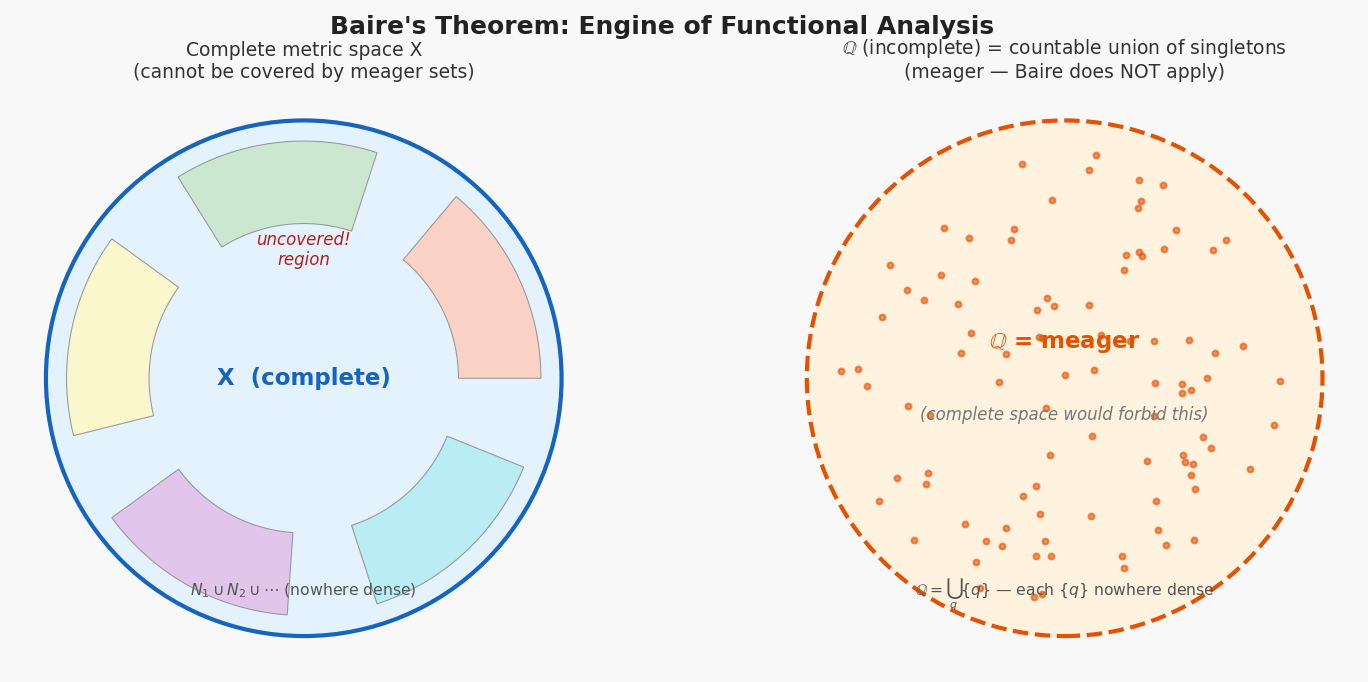 চিত্র ১: বাঁয়ে — complete metric space \(X\): রঙিন আর্কগুলো nowhere-dense স্তর; এদের সব একত্র করেও পুরো disk ঢাকা যায় না — মাঝখানে uncovered অঞ্চল থাকে। ডানে — \(\mathbb{Q}\) incomplete এবং meager: সব singleton-এর union \(\mathbb{Q}\)-কে দেয়, Baire এখানে প্রযোজ্য নয়।
এই Baire-ই তিনটি উপপাদ্যের সাধারণ proof কাঠামো দেয়:
- ধরো কোনো ধর্ম ব্যর্থ হচ্ছে।
- দেখাও ব্যর্থ হওয়ার সেটগুলো nowhere-dense।
- Baire বলে তাহলে সব সেট মিলে পুরো space ঢাকতে পারে না — বিরোধ।
Open Mapping — খোলা সেট খোলা থাকে
সাধারণ analysis-এ একটা continuous function open set-কে open-এ নিয়ে যায় না। কিন্তু Banach space-এ surjective bounded operator-এর ক্ষেত্রে এটা সত্য!
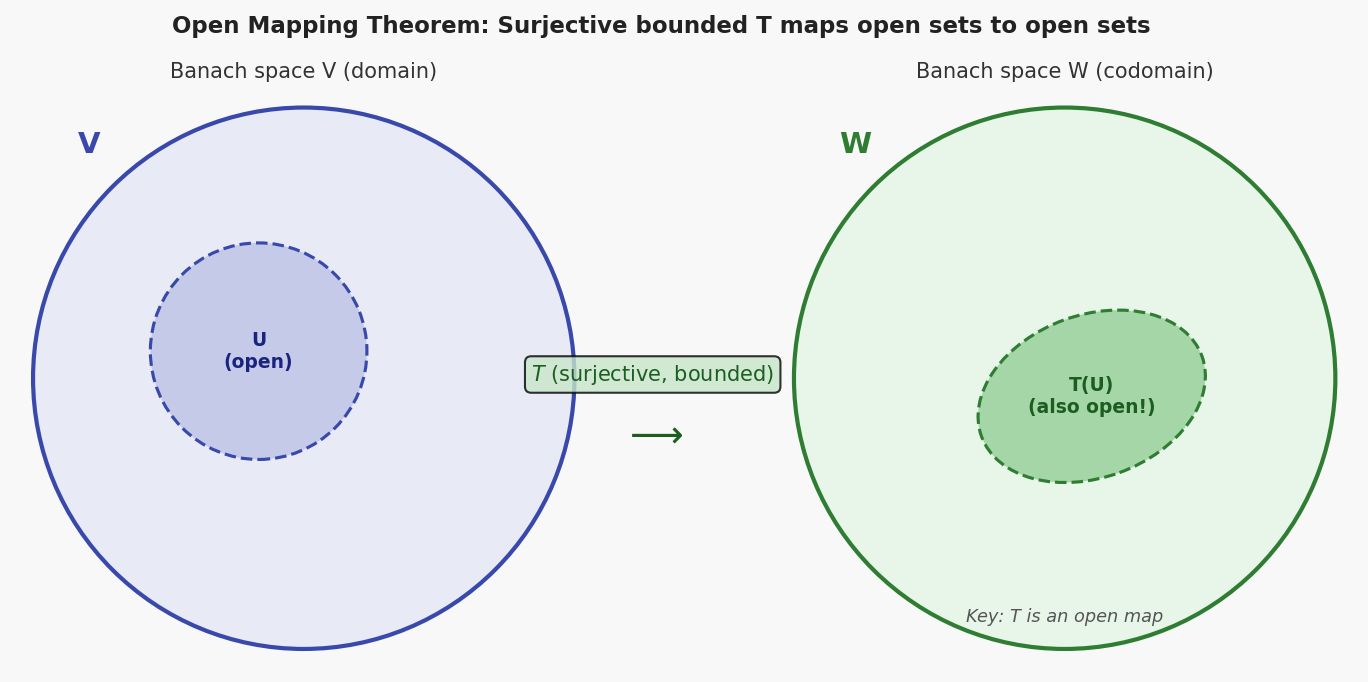 চিত্র ২: বাঁয়ে — Banach space \(V\)-এ open set \(U\) (নীল বৃত্ত)। ডানে — surjective bounded \(T\) map করলে \(T(U)\) আবার open হয় \(W\)-তে (সবুজ ellipse)। \(T\) একটা open mapping।
স্বজ্ঞা: \(T\) surjective বলে \(W = \bigcup_k T(kB)\) যেখানে \(B\) হলো \(V\)-এর unit ball (একক গোলক)। Baire বলে কোনো একটা \(T(kB)\)-র interior nonempty। তার মানে \(T\) open ball-কে open ball-এর ভেতরে নিয়ে যায় — অর্থাৎ open mapping।
Bounded Inverse — বিপরীতও সীমাবদ্ধ
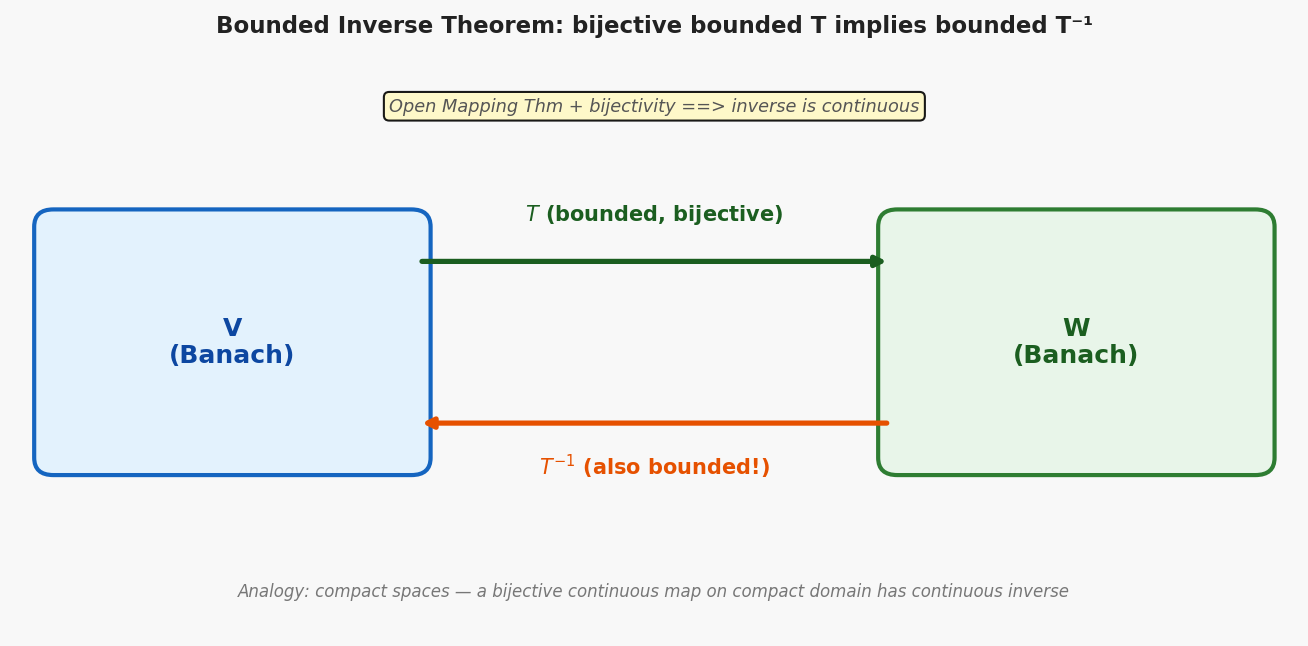 চিত্র ৩: \(V\) এবং \(W\) Banach space। \(T\) bijective bounded হলে \(T^{-1}\) স্বয়ংক্রিয়ভাবে bounded। Forward arrow: \(T\) (bounded); backward arrow: \(T^{-1}\) (automatically bounded via Open Mapping Thm)।
স্বজ্ঞা: \(T^{-1}\)-এর bounded হওয়া মানে \(T\)-এর inverse image-এ open set open থাকা — সেটাই Open Mapping Theorem দেয়।
Closed Graph — graph দেখলেই বোঝা যায়
একটা linear map \(T: V \to W\)-এর graph (লেখচিত্র) হলো \(V \times W\)-এ সেট \(\{(f, Tf) : f \in V\}\)।
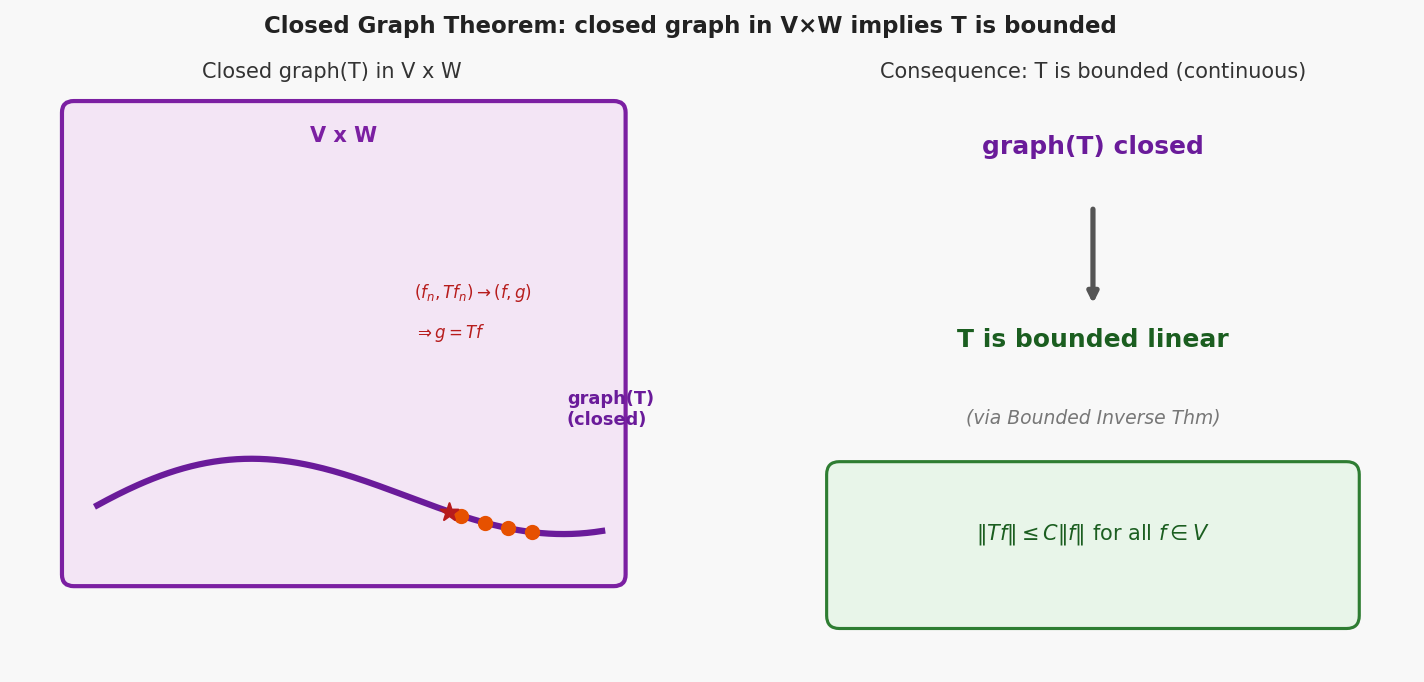 চিত্র ৪: বাঁয়ে — \(V \times W\)-এ graph(T) একটা curve; অনুক্রম \((f_n, Tf_n) \to (f, g)\) হলে \(g = Tf\) (limit point graph-এই থাকে)। ডানে — এই closed graph condition থেকেই \(T\) bounded হয়।
স্বজ্ঞা: \(T\) bounded না হলে graph "ছিটকে যায়" — এমন অনুক্রম পাওয়া যায় যার limit graph-এ নেই। তাই graph closed থাকলে \(T\)-কে bounded হতে হবে।
Uniform Boundedness — পয়েন্টওয়াইজ থেকে ইউনিফর্ম
একটা পরিবার \(\mathcal{A} = \{T_\alpha\}\) bounded linear map, যেখানে প্রতিটা \(f \in V\)-এর জন্য \(\sup_\alpha \lVert T_\alpha f \rVert < \infty\)। Uniform Boundedness Principle (UBP) বলে তাহলে \(\sup_\alpha \lVert T_\alpha \rVert < \infty\)।
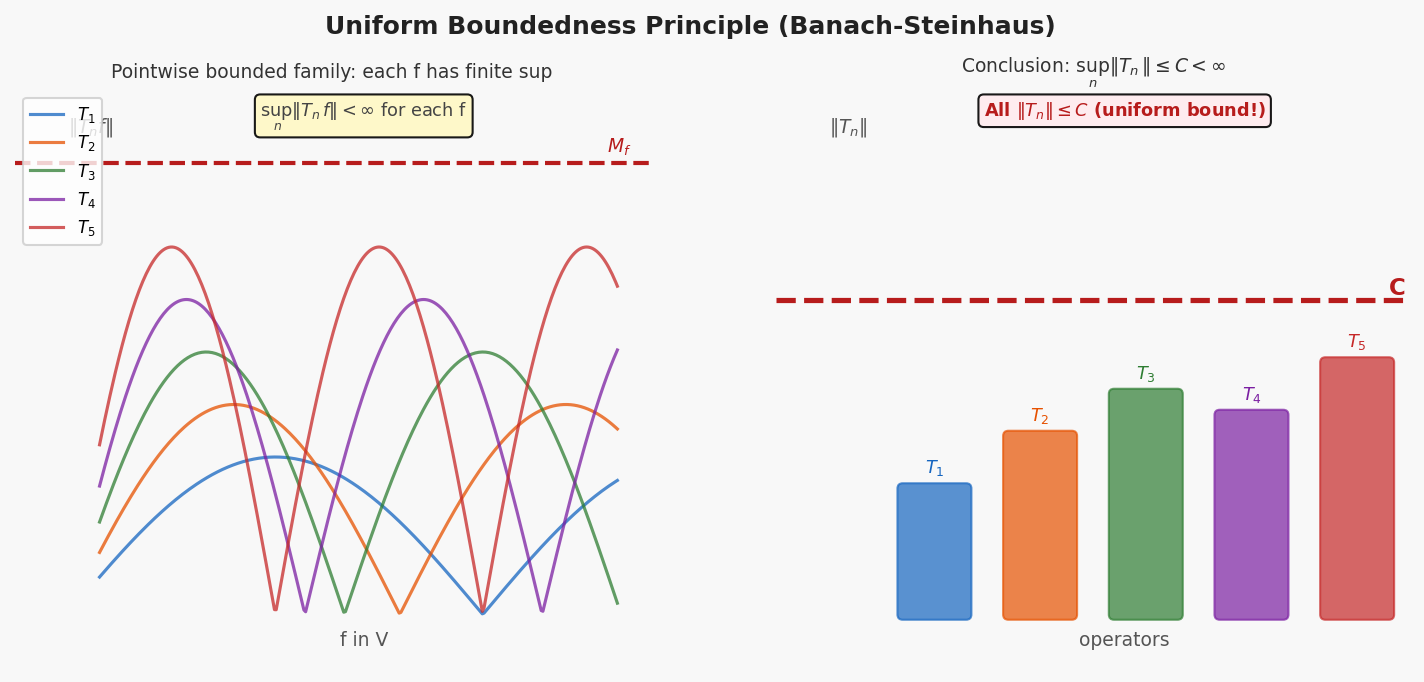 চিত্র ৫: বাঁয়ে — প্রতিটা \(f\)-এর জন্য operator-family-র মান সীমিত (রঙিন তরঙ্গ, প্রতিটার নিজস্ব ceiling \(M_f\))। ডানে — UBP বলে সব operator-এর norm একটাই সাধারণ ceiling \(C\)-এর নিচে।
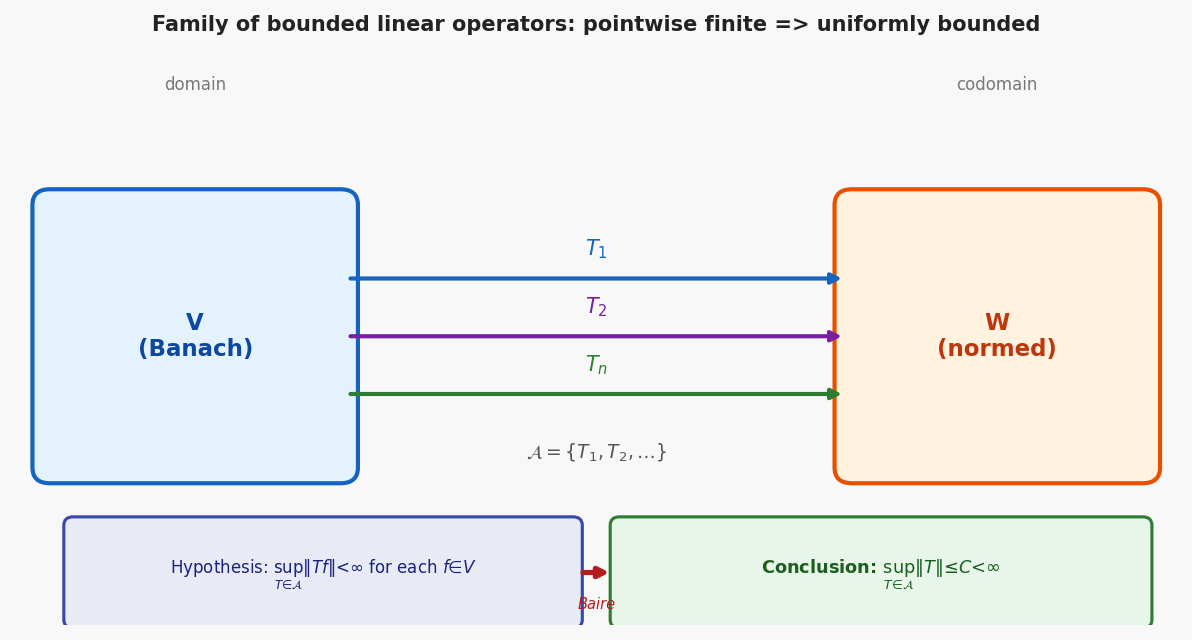 চিত্র ৬: \(V\) (Banach) থেকে \(W\) (normed)-এ multiple operator \(T_1, T_2, \ldots\) — hypothesis: প্রতিটা \(f\)-এ pointwise finite; conclusion (Baire দিয়ে): uniform bound \(C\)।
৩. সংজ্ঞা ও উপপাদ্য (Definitions & Theorems)
Baire Category Theorem (পুনরায়)
উপপাদ্য: Baire Category Theorem (René-Louis Baire, 1899) — 2.9 থেকে
একটা complete metric space \((X, d)\) second category — অর্থাৎ \(X\) কে countably many nowhere-dense সেটের union হিসেবে লেখা যায় না।
সমতুল্য রূপ: যদি \(X = \bigcup_{n=1}^{\infty} F_n\) যেখানে প্রতিটা \(F_n\) closed, তাহলে অন্তত একটা \(F_n\)-এর interior nonempty।
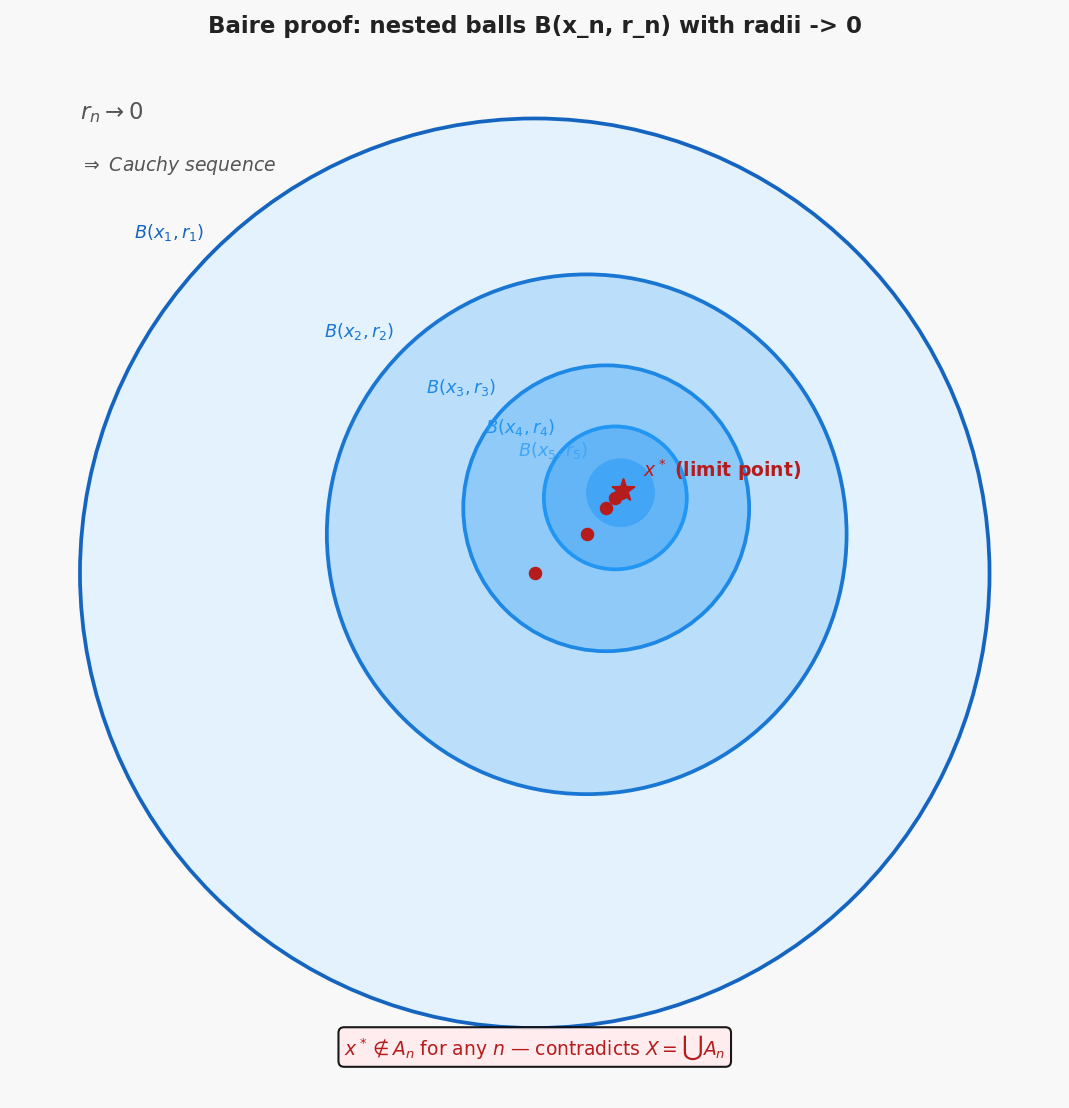 চিত্র ৭: Baire-এর proof-এর nested balls — \(B(x_1, r_1) \supseteq B(x_2, r_2) \supseteq \cdots\), radii \(r_n \to 0\); কেন্দ্রগুলো Cauchy sequence, limit \(x^*\) কোনো \(A_n\)-এ নেই — বিরোধ।
Open Mapping Theorem
উপপাদ্য: Open Mapping Theorem (Banach–Schauder, 1929–30)
ধরো \(V\) এবং \(W\) Banach space (ব্যানাখ স্থান) এবং \(T: V \to W\) একটা surjective (সর্বব্যাপী) bounded linear map।
তাহলে \(T\) একটা open mapping (খোলা চিত্রণ) — অর্থাৎ \(V\)-এর প্রতিটা open set-এর image \(W\)-এ open।
Proof sketch (Baire দিয়ে):
ধরো \(B = \{f \in V : \lVert f \rVert < 1\}\) \(V\)-এর open unit ball।
ধাপ ১: \(T\) surjective বলে \(W = T(V) = \bigcup_{k=1}^{\infty} T(kB) = \bigcup_{k=1}^{\infty} k \cdot T(B)\)।
\(W\) complete, Baire theorem বলে কোনো \(k\)-এর জন্য \(\overline{kT(B)}\)-এর interior nonempty। তাই \(\overline{T(B)}\)-এর interior nonempty।
ধাপ ২: \(\overline{T(B)}\)-তে \(0\) কোনো open ball-এর কেন্দ্র — ধরো \(B_W(0, 2r) \subseteq \overline{T(B)}\)।
ধাপ ৩ (closure সরানো): এবার দেখাই \(B_W(0, r) \subseteq T(B)\) (closure ছাড়া)। একটা Cauchy series argument ব্যবহার করি: যেকোনো \(g \in B_W(0, r)\)-এর জন্য, \(\overline{T(B)}\)-এর ঘনত্ব ব্যবহার করে \(V\)-এ একটা absolutely convergent series পাই \(f = \sum f_k\) যেন \(\lVert f \rVert < 1\) এবং \(Tf = g\)।
\(V\) complete বলে series converges; surjectivity বলে \(g = Tf \in T(B)\)। \(\blacksquare\)
Bounded Inverse Theorem
উপপাদ্য: Bounded Inverse Theorem (বিপরীত সীমাবদ্ধতা উপপাদ্য)
ধরো \(V\) এবং \(W\) Banach space এবং \(T: V \to W\) একটা bijective (একৈক ও সর্বব্যাপী) bounded linear map।
তাহলে \(T^{-1}: W \to V\) একটা bounded linear map।
Proof:
\(T\) bijective হওয়ায় \(T^{-1}\) linear (সরাসরি যাচাই)।
\(T\) bounded এবং bijective বলে \(T\) surjective, তাই Open Mapping Theorem প্রযোজ্য। সুতরাং \(T\) open mapping — \(V\)-এর প্রতিটা open set-এর image \(W\)-এ open।
\((T^{-1})^{-1}(G) = T(G)\) সব \(G \subseteq V\)-এর জন্য। \(T\) open mapping বলে \(G\) open হলে \(T(G)\) open। তাই \(T^{-1}\)-এর প্রতিটা open set-এর preimage open — অর্থাৎ \(T^{-1}\) continuous, মানে bounded। \(\blacksquare\)
Banach space দুটোতেই লাগবে
শুধু \(V\) বা শুধু \(W\) Banach হলে চলবে না — উভয়কেই complete হতে হবে। Exercise 13 ও 14 (Axler 6E) counterexample দেয়।
Closed Graph Theorem
সংজ্ঞা: Graph of a linear map
\(T: V \to W\) linear map। এর graph (লেখচিত্র) হলো:
Product space \(V \times W\)-এ norm: \(\lVert (f, g) \rVert = \max\{\lVert f \rVert_V, \lVert g \rVert_W\}\)।
উপপাদ্য: Closed Graph Theorem (বদ্ধ লেখচিত্র উপপাদ্য)
ধরো \(V\) এবং \(W\) Banach space এবং \(T: V \to W\) একটা function।
তাহলে \(T\) bounded linear map যদি এবং কেবল যদি \(\text{graph}(T)\) হলো \(V \times W\)-এর closed subspace।
Proof sketch:
(\(\Rightarrow\)) \(T\) bounded হলে graph(T) closed: অনুক্রম \((f_n, Tf_n) \to (f, g)\) ধরো। \(T\) continuous বলে \(Tf_n \to Tf\)। তাই \(g = Tf\), অর্থাৎ \((f, g) \in \text{graph}(T)\)। \(\checkmark\)
(\(\Leftarrow\)) graph(T) closed হলে \(T\) bounded: \(\text{graph}(T)\) closed subspace of a Banach space, তাই নিজেও Banach। Define \(S: \text{graph}(T) \to V\) by \(S(f, Tf) = f\)।
\(\lVert S(f, Tf) \rVert = \lVert f \rVert \le \lVert (f, Tf) \rVert\), তাই \(S\) bounded, \(\lVert S \rVert \le 1\)।
\(S\) clearly bijective। Bounded Inverse Theorem বলে \(S^{-1}: V \to \text{graph}(T)\) bounded। কিন্তু \(S^{-1} f = (f, Tf)\), তাই:
অর্থাৎ \(T\) bounded। \(\blacksquare\)
Uniform Boundedness Principle
উপপাদ্য: Uniform Boundedness Principle / Banach–Steinhaus Theorem (Stefan Banach ও Hugo Steinhaus, 1927)
ধরো \(V\) Banach space, \(W\) normed vector space (নর্মড ভেক্টর স্থান), এবং \(\mathcal{A}\) হলো \(V\) থেকে \(W\)-তে bounded linear map-এর একটা পরিবার।
Hypothesis: প্রতিটা \(f \in V\)-এর জন্য \(\sup\{\lVert Tf \rVert : T \in \mathcal{A}\} < \infty\)।
Conclusion:
Proof (Baire দিয়ে):
সংজ্ঞা করি \(V_n = \{f \in V : \lVert Tf \rVert \le n \text{ for all } T \in \mathcal{A}\}\)।
Hypothesis বলে \(V = \bigcup_{n=1}^{\infty} V_n\)।
প্রতিটা \(T\) continuous বলে \(V_n\) closed। \(V\) complete (Banach), Baire theorem বলে কোনো \(V_n\)-এর interior nonempty। অর্থাৎ কোনো \(h \in V\) এবং \(r > 0\) দিয়ে \(B(h, r) \subseteq V_n\)।
এখন যেকোনো \(g \in V\), \(\lVert g \rVert < 1\) নিই। তাহলে \(rg + h, h \in B(h, r) \subseteq V_n\)।
যেকোনো \(T \in \mathcal{A}\)-এর জন্য:
তাই \(\lVert T \rVert \le 2n/r < \infty\) সব \(T \in \mathcal{A}\)-এর জন্য, uniformly। \(\blacksquare\)
৪. উদাহরণ ও Analogy
Analogy — কোরাস গান
ধরো একটা কোরাসে (chorus) অনেক গায়ক। প্রতিটা গায়ক একটা বিশেষ সুরে বেশি উচ্চ গান করে না (pointwise bounded)। Uniform Boundedness Principle বলে: যদি কোরাস পরিচালক (conductor) নিশ্চিত করেন পুরো দলটা কোনো শিল্পীর চিৎকারে পরিপূর্ণ হয়ে না যায়, তাহলে পুরো দলের নিজস্ব "maximum volume" একটা সাধারণ ceiling-এর নিচে।
Worked Example ১: Differentiation operator is not bounded
\(V = C^1[0,1]\) (continuously differentiable functions with \(\lVert f \rVert_\infty = \sup |f|\)), \(W = C[0,1]\)। Define \(Df = f'\)।
\(D\) linear কিন্তু bounded নয় (unbounded): ধরো \(f_n(x) = \sin(nx)/\sqrt{n}\)। তাহলে \(\lVert f_n \rVert_\infty = 1/\sqrt{n} \to 0\) কিন্তু \(\lVert Df_n \rVert_\infty = \sqrt{n} \to \infty\)।
Closed Graph Theorem বলে তাহলে \(\text{graph}(D)\) closed নয় — সত্যিই: \(f_n \to 0\) uniformly, \(f_n' = \sqrt{n}\cos(nx)\) which does not converge uniformly — graph limit \(V \times W\)-এ \((0, g)\) যেখানে \(g \ne D(0) = 0\)।
Worked Example ২: Fourier series divergence
দাবি: এমন continuous function \(f \in C[-\pi, \pi]\) আছে যার Fourier partial sums কোনো বিন্দুতে diverge করে।
যুক্তি (UBP দিয়ে):
Define \(S_n: C[-\pi, \pi] \to \mathbb{R}\) by \(S_n f = \frac{1}{2\pi} \int_{-\pi}^{\pi} f(t) D_n(t)\, dt\) যেখানে \(D_n\) Dirichlet kernel।
জানা যায় \(\lVert S_n \rVert = \frac{1}{2\pi} \int_{-\pi}^{\pi} \lvert D_n(t) \rvert\, dt \sim \frac{4}{\pi^2} \ln n \to \infty\)।
যদি সব \(f \in C[-\pi, \pi]\)-এর জন্য \(S_n f\) সব জায়গায় converge করত, তাহলে \(\sup_n \lvert S_n f \rvert < \infty\) প্রতিটা \(f\)-এর জন্য (pointwise)। UBP বলে তাহলে \(\sup_n \lVert S_n \rVert < \infty\) — বিরোধ।
তাই কোনো \(f \in C[-\pi, \pi]\) এবং বিন্দু \(x\) আছে যেখানে \(S_n f(x)\) diverge করে।
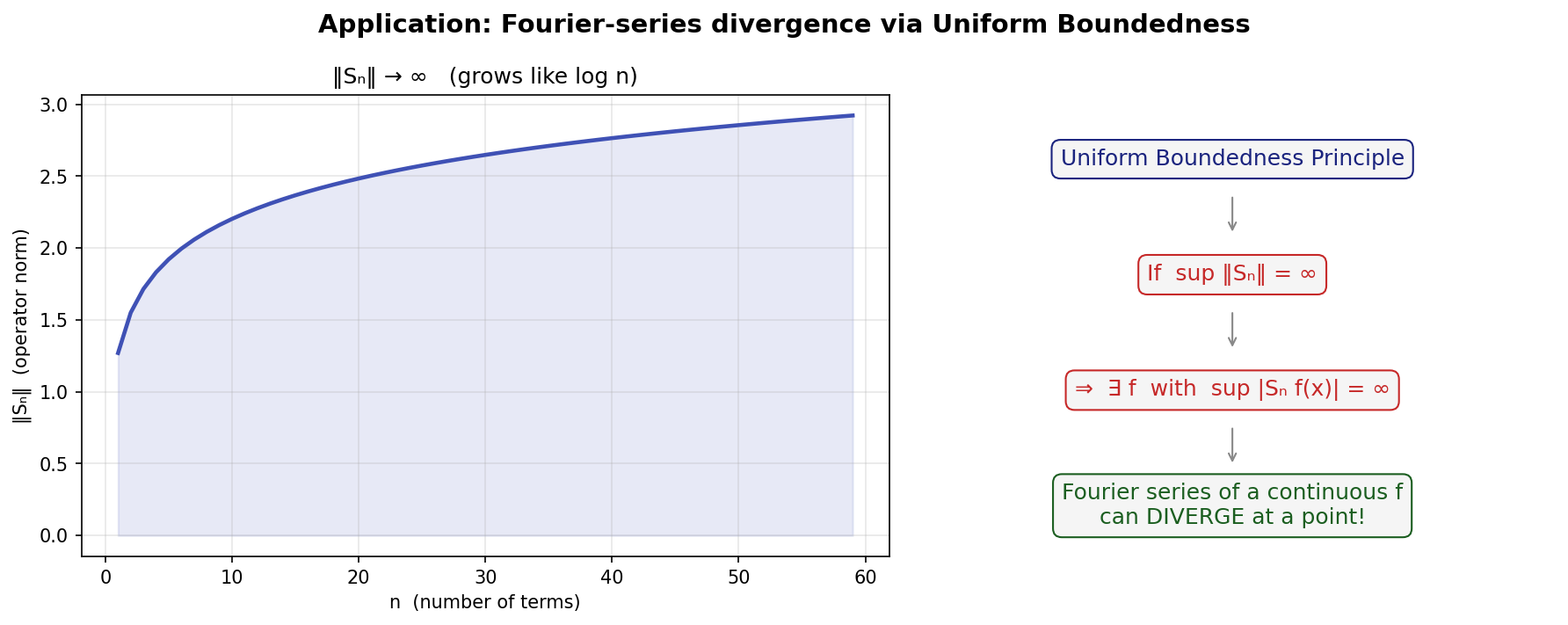 চিত্র ৮: বাঁয়ে — Fourier partial sum operator-এর norm \(\lVert S_n \rVert \sim \frac{4}{\pi^2} \ln n \to \infty\) (নীল curve)। ডানে — UBP-এর contrapositive ব্যবহার করে দেখানো হয় এমন \(f\) থাকে যার Fourier series diverge করে।
Worked Example ৩: Closed Graph চেক করা
\(T: \ell^2 \to \ell^2\) define করি \(T(x_1, x_2, x_3, \ldots) = (x_1, 2x_2, 3x_3, \ldots)\) (n-th coordinate-কে \(n\) দিয়ে গুণ)।
\(T\) linear কিন্তু unbounded: \(e_n = (0,\ldots,0,1,0,\ldots)\) (n-th standard basis) নিলে \(\lVert e_n \rVert = 1\) কিন্তু \(\lVert Te_n \rVert = n \to \infty\)।
Closed Graph Theorem বলে graph(\(T\)) closed নয়। সত্যি: \(f_n = e_n / n \to 0\) কিন্তু \(T(e_n/n) = e_n\) যা converge করে না — limit \((0, Tf)\)-তে নেই।
৫. সাধারণ ভুল (Common mistakes)
-
Completeness ছাড়া apply করা। তিনটি উপপাদ্যই \(V\) (এবং Open Mapping-এ \(W\)-ও) Banach space ধরে। শুধু normed space হলে চলবে না। উদাহরণ: \(C^1[0,1]\) to \(C[0,1]\) (differentiation) — source space complete নয় (under sup norm), তাই Bounded Inverse Theorem প্রযোজ্য নয়।
-
Open Mapping = Open Function ভাবা। Open Mapping Theorem বলে \(T\) open image-এর দিক থেকে open — কিন্তু \(T\) closed mapping নাও হতে পারে, injective নাও হতে পারে।
-
Closed Graph Theorem-এ linearity ভুলে যাওয়া। শুধু graph closed হলেই bounded হয় না — \(T\) linear হতে হবে। একটা non-linear function-এর graph closed হতে পারে কিন্তু সে continuous নাও হতে পারে।
-
UBP-এ \(V\) Banach না হলেও ভাবা। Codomain \(W\) শুধু normed হলে চলে (Banach লাগে না), কিন্তু domain \(V\) অবশ্যই Banach। Completeness-ই Baire-এর চাবিকাঠি।
-
Bounded Inverse Theorem-এ শুধু একটা space Banach ধরা। উভয় \(V\) ও \(W\) Banach লাগবে। Axler Exercise 13 এবং 14 counterexample দেয় যেখানে একটা space শুধু normed — inverse তখন unbounded হতে পারে।
-
"Surjective" শর্ত Open Mapping-এ ভুলে যাওয়া। Bounded linear map সবসময় open mapping হয় না — surjectivity আবশ্যক। উদাহরণ: \(\ell^2 \hookrightarrow \ell^2\) (identity on a closed proper subspace) open mapping নয়।
৬. এক্সারসাইজ (Exercises)
নিজে চেষ্টা করো, তারপর নিচের সমাধান খোলো।
-
\(T: V \to W\) surjective bounded linear map, \(V, W\) Banach। দেখাও \(T(B(0,1))\) (open unit ball-এর image) \(W\)-তে একটা open neighborhood of 0 ধারণ করে।
-
\(V\) Banach space, \(T: V \to V\) bounded linear, bijective। \(T^{-1}\) কি bounded? কেন?
-
\(T: V \to W\) linear map, \(V, W\) Banach। ধরো \(\text{graph}(T) = \{(f, Tf)\}\) closed in \(V \times W\)। এমন একটা sequence \((f_n)\) দাও যেন \(f_n \to f\) কিন্তু \(\lVert Tf_n - Tf \rVert \not\to 0\) — সম্ভব কিনা?
-
\(\mathcal{A} = \{T_n\}\) where \(T_n: \ell^1 \to \ell^1\), \(T_n(x) = (x_1, x_2, \ldots, x_n, 0, 0, \ldots)\) (প্রথম \(n\) coordinate রেখে বাকি শূন্য)। দেখাও \(\sup_n \lVert T_n f \rVert < \infty\) সব \(f \in \ell^1\)-এর জন্য এবং \(\sup_n \lVert T_n \rVert\) কত?
-
\(T: C[0,1] \to C[0,1]\) define করো \(Tf(x) = xf(x)\)। \(T\) কি bounded? \(T\) কি open mapping?
-
Uniform Boundedness Principle-এর contrapositive (বিপরীত প্রতিনিধি) লেখো এবং Fourier series application-এ কীভাবে প্রয়োগ হয় ব্যাখ্যা করো।
-
\(V = C[0,1]\) (sup-norm), \(T_n: V \to \mathbb{R}\) define করো \(T_n f = n \int_0^{1/n} f(t) \, dt\)। দেখাও \(\lVert T_n \rVert = 1\) সব \(n\)-এর জন্য। UBP এখানে প্রযোজ্য?
-
চ্যালেঞ্জ: \(V\) একটা Banach space এবং \(T: V \to V\) একটা bijective bounded linear operator। যদি \(\lVert T^n \rVert \le M\) সব \(n \in \mathbb{Z}\)-এর জন্য (uniformly bounded powers), তাহলে দেখাও \(T\) একটা isometry-র সাথে similar (isomorphic)।
৭. সমাধান (ব্যাখ্যাসহ)
১-নং সমাধান দেখাও
দাবি: \(T(B(0,1))\) একটা open neighborhood of 0 ধারণ করে।
প্রমাণ: Open Mapping Theorem বলে \(T\) একটা open mapping (কারণ \(T\) surjective bounded এবং \(V, W\) Banach)।
\(B(0,1)\) হলো \(V\)-এ একটা open set। \(T\) open mapping বলে \(T(B(0,1))\) হলো \(W\)-এ একটা open set।
\(T(0) = 0 \in T(B(0,1))\) (কারণ \(0 \in B(0,1)\))।
\(T(B(0,1))\) open এবং \(0 \in T(B(0,1))\), তাই এটা 0-এর একটা open neighborhood ধারণ করে। \(\checkmark\)
২-নং সমাধান দেখাও
হ্যাঁ, \(T^{-1}\) bounded।
\(T: V \to V\) bounded linear bijective। \(V\) Banach (একটাই space)।
Bounded Inverse Theorem বলে: যদি \(T\) bijective bounded linear এবং domain-codomain উভয়ই Banach, তাহলে \(T^{-1}\) bounded।
এখানে domain = codomain = \(V\) (Banach)। শর্ত পূর্ণ। তাই \(T^{-1}\) bounded। \(\checkmark\)
৩-নং সমাধান দেখাও
না, এটা সম্ভব নয়।
Closed Graph Theorem বলে: \(T\) linear, \(\text{graph}(T)\) closed, \(V, W\) Banach \(\Rightarrow\) \(T\) bounded।
\(T\) bounded মানে \(T\) continuous। Continuous মানে: \(f_n \to f \Rightarrow Tf_n \to Tf\)।
তাই \(f_n \to f\) হলে \(\lVert Tf_n - Tf \rVert \to 0\) হতে বাধ্য। এমন sequence পাওয়া সম্ভব নয়। \(\checkmark\)
৪-নং সমাধান দেখাও
দাবি: \(\sup_n \lVert T_n f \rVert < \infty\) এবং \(\sup_n \lVert T_n \rVert = 1\)।
Pointwise bound: যেকোনো \(f = (x_k) \in \ell^1\),
তাই \(\sup_n \lVert T_n f \rVert_1 \le \lVert f \rVert_1 < \infty\)। \(\checkmark\)
Operator norm: \(\lVert T_n \rVert = \sup_{\lVert f \rVert = 1} \lVert T_n f \rVert_1 \le 1\) সবসময়। কিন্তু \(f = e_1 = (1, 0, 0, \ldots)\) নিলে \(\lVert T_n e_1 \rVert_1 = 1\)। তাই \(\lVert T_n \rVert = 1\) সব \(n\)-এর জন্য। \(\sup_n \lVert T_n \rVert = 1 < \infty\)। \(\checkmark\)
UBP এখানে verify করা যাচ্ছে directly — pointwise bound আছে এবং uniform bound \(= 1\) আছে।
৫-নং সমাধান দেখাও
\(T\) bounded: \(\lVert Tf \rVert_\infty = \sup_{x \in [0,1]} \lvert x f(x) \rvert \le \sup_{x} \lvert x \rvert \cdot \sup_x \lvert f(x) \rvert = 1 \cdot \lVert f \rVert_\infty\)। তাই \(\lVert T \rVert \le 1\)। \(T\) bounded। \(\checkmark\)
\(T\) open mapping নয়: \(T\) surjective নয় — কারণ range\((T)\) শুধু functions that vanish at 0। যেমন constant function \(g(x) = 1 \notin \text{range}(T)\) (কারণ \((xf(x))\big|_{x=0} = 0 \ne 1\))।
Open Mapping Theorem শুধু surjective bounded operator-এর জন্য প্রযোজ্য। \(T\) surjective নয় বলে open mapping নাও হতে পারে — এবং সত্যিই এখানে open mapping নয়। \(\checkmark\)
৬-নং সমাধান দেখাও
UBP-এর contrapositive:
মূল: "pointwise bounded \(\Rightarrow\) uniformly bounded।"
Contrapositive: "uniformly unbounded \(\Rightarrow\) কোনো \(f\)-এ pointwise unbounded।"
সুনির্দিষ্টভাবে: যদি \(\sup_{T \in \mathcal{A}} \lVert T \rVert = \infty\), তাহলে কোনো \(f \in V\) আছে যেন \(\sup_{T \in \mathcal{A}} \lVert Tf \rVert = \infty\)।
Fourier application: Fourier partial sum operator \(S_n: C[-\pi,\pi] \to \mathbb{R}\) এর \(\lVert S_n \rVert \sim \frac{4}{\pi^2} \ln n \to \infty\)।
Contrapositive বলে: কোনো \(f \in C[-\pi,\pi]\) আছে যেন \(\sup_n \lvert S_n f \rvert = \infty\) — অর্থাৎ কোথাও Fourier series diverge করে।
এইভাবে UBP-এর contrapositive directly "bad" function-এর অস্তিত্ব দেয়, explicit construction ছাড়া। \(\checkmark\)
৭-নং সমাধান দেখাও
\(\lVert T_n \rVert = 1\) প্রমাণ:
\(T_n f = n \int_0^{1/n} f(t) \, dt\), একটা real number।
তাই \(\lVert T_n \rVert \le 1\)।
\(f \equiv 1\) নিলে \(T_n(1) = n \cdot \frac{1}{n} = 1\)। তাই \(\lVert T_n \rVert = 1\)। \(\checkmark\)
UBP প্রযোজ্যতা: \(\sup_n \lVert T_n \rVert = 1 < \infty\) — সুতরাং operator family \(\{T_n\}\) uniformly bounded। UBP-এর hypothesis এবং conclusion উভয়ই পূর্ণ (trivially)। এটা UBP-এর একটা সরল উদাহরণ যেখানে uniform bound-টা সহজেই মিলে যায়। \(\checkmark\)
৮-নং সমাধান দেখাও
Proof sketch:
Define \(\mathcal{A} = \{T^n : n \in \mathbb{Z}\}\)। Hypothesis: \(\sup_{n \in \mathbb{Z}} \lVert T^n \rVert \le M < \infty\)।
প্রতিটা \(f \in V\)-এর জন্য \(\sup_{n} \lVert T^n f \rVert \le M \lVert f \rVert < \infty\) — pointwise bounded।
নতুন norm সংজ্ঞা: \(\lVert\!\lvert f \rvert\!\rVert = \sup_{n \in \mathbb{Z}} \lVert T^n f \rVert\)।
এটা একটা norm (verify করতে হবে) এবং \(\lVert f \rVert \le \lVert\!\lvert f \rvert\!\rVert \le M \lVert f \rVert\)।
দুই norm-এর equivalence (সমতুল্যতা) আছে, তাই \(V\) নতুন norm-এও Banach।
নতুন norm-এ \(T\) isometry: \(\lVert\!\lvert Tf \rvert\!\rVert = \sup_n \lVert T^{n+1} f \rVert = \sup_n \lVert T^n f \rVert = \lVert\!\lvert f \rvert\!\rVert\)।
তাই \(T\) নতুন norm-এ একটা isometry, এবং নতুন ও পুরনো norm equivalent। সুতরাং \(T\) original norm-এ একটা isometry-র সাথে similar। \(\checkmark\)
৮. সারসংক্ষেপ ও Checklist
- [ ] Baire Category Theorem এই অধ্যায়ের ইঞ্জিন: complete metric space = second category — nowhere-dense-এর countable union নয়।
- [ ] Open Mapping Theorem বলতে পারি: surjective bounded \(T\) (Banach to Banach) open mapping।
- [ ] Proof strategy জানি: \(W = \bigcup T(kB)\), Baire দিয়ে nonempty interior, তারপর closure সরিয়ে actual openness।
- [ ] Bounded Inverse Theorem বলতে পারি: bijective bounded \(T\) (Banach to Banach) implies \(T^{-1}\) bounded।
- [ ] Closed Graph Theorem বলতে পারি: \(T\) bounded \(\iff\) graph(\(T\)) closed (Banach to Banach)।
- [ ] UBP / Banach–Steinhaus বলতে পারি: pointwise bounded family (Banach domain) \(\Rightarrow\) uniformly bounded।
- [ ] UBP-এর proof জানি: \(V_n\) closed, Baire দিয়ে nonempty interior, তারপর uniform bound বের করা।
- [ ] Fourier divergence উদাহরণটা বুঝি: \(\lVert S_n \rVert \to \infty\), UBP-এর contrapositive, কোনো \(f\)-এ divergence।
- [ ] সাধারণ ভুল জানি: completeness দুটো space-এ লাগতে পারে; surjectivity Open Mapping-এ আবশ্যক।
➡️ পরের অধ্যায়: 4.7 — Lᵖ Space: Hölder ও Minkowski — measure space থেকে তৈরি \(L^p\) spaces, Hölder inequality (হোল্ডার অসমতা) এবং Minkowski inequality (মিনকোউস্কি অসমতা) — এবং দেখব \(L^p\) কীভাবে একটি পূর্ণ Banach space গঠন করে।