7.6 — Stone's Theorem¶
এই অধ্যায়ে কী শিখব: strongly-continuous one-parameter unitary group (শক্তিশালীভাবে ক্রমাগত এক-প্যারামিটার ইউনিটারি গ্রুপ) \(U(t)\) — \(U(s+t) = U(s)U(t)\), \(U(0) = I\); Stone's theorem: এমন প্রতিটা group-এর জন্য exactly একটা self-adjoint generator \(A\) আছে যাতে \(U(t) = e^{itA}\); generator \(A\) হলো "\(-i\) গুণ \(t=0\)-এ \(U(t)\)-এর derivative"; Schrödinger equation-এর সাথে সংযোগ (quantum time evolution); conservation laws; এবং \(L^2(\mathbb{R})\)-এ translation group-এর উদাহরণ।
উৎস (source): Marshall Stone; von Neumann।
১. কেন শিখব? (Motivation)¶
Quantum mechanics (কোয়ান্টাম মেকানিক্স)-এ time evolution (কাল-বিবর্তন) একটা মৌলিক প্রশ্ন: যদি \(t=0\)-এ system-এর state হয় \(\psi_0\), তাহলে \(t\) সময় পরে state কী হবে?
Schrödinger (শ্রোডিঙার) দিয়েছেন উত্তর:
যেখানে \(H\) (Hamiltonian, হামিলটোনিয়ান) হলো একটা self-adjoint operator। এর formal solution: \(\psi(t) = e^{-itH/\hbar} \psi_0\)। কিন্তু \(H\) unbounded হলে \(e^{-itH}\) কীভাবে সংজ্ঞায়িত হবে? এটা একটা নন-ট্রিভিয়াল প্রশ্ন।
Stone's theorem (স্টোনের উপপাদ্য) এর উত্তর দেয়। এটা বলে: strongly-continuous one-parameter unitary group-এর ধারণাটাই হলো quantum time evolution-এর সঠিক mathematical framework — এবং এধরনের প্রতিটি group exactly একটা self-adjoint (possibly unbounded) generator \(A\) নির্ধারণ করে।
মূল স্বজ্ঞা
Stone's theorem = Lie group theory-র সবচেয়ে সুন্দর উদাহরণ: \((\mathbb{R}, +)\) এবং Hilbert space \(H\)-এর unitary group \(\mathcal{U}(H)\)-এর মধ্যে continuous homomorphism আর একটা self-adjoint operator এক-এক সম্পর্কযুক্ত।
২. মূল ধারণা (Core idea)¶
One-Parameter Unitary Group — কী জিনিস?¶
একটা Hilbert space \(H\)-এ one-parameter unitary group (এক-প্যারামিটার ইউনিটারি গ্রুপ) হলো একটা map \(t \mapsto U(t)\) (যেখানে \(t \in \mathbb{R}\), \(U(t): H \to H\) bounded) যা সন্তুষ্ট করে:
- Unitarity (ইউনিটারিত্ব): \(U(t)^* = U(t)^{-1}\) — norm preserve করে।
- Group homomorphism: \(U(s+t) = U(s)U(t)\) এবং \(U(0) = I\)।
- Strong continuity (শক্তিশালী ক্রমাগততা): \(t \mapsto U(t)\psi\) continuous সব \(\psi \in H\)-এর জন্য।
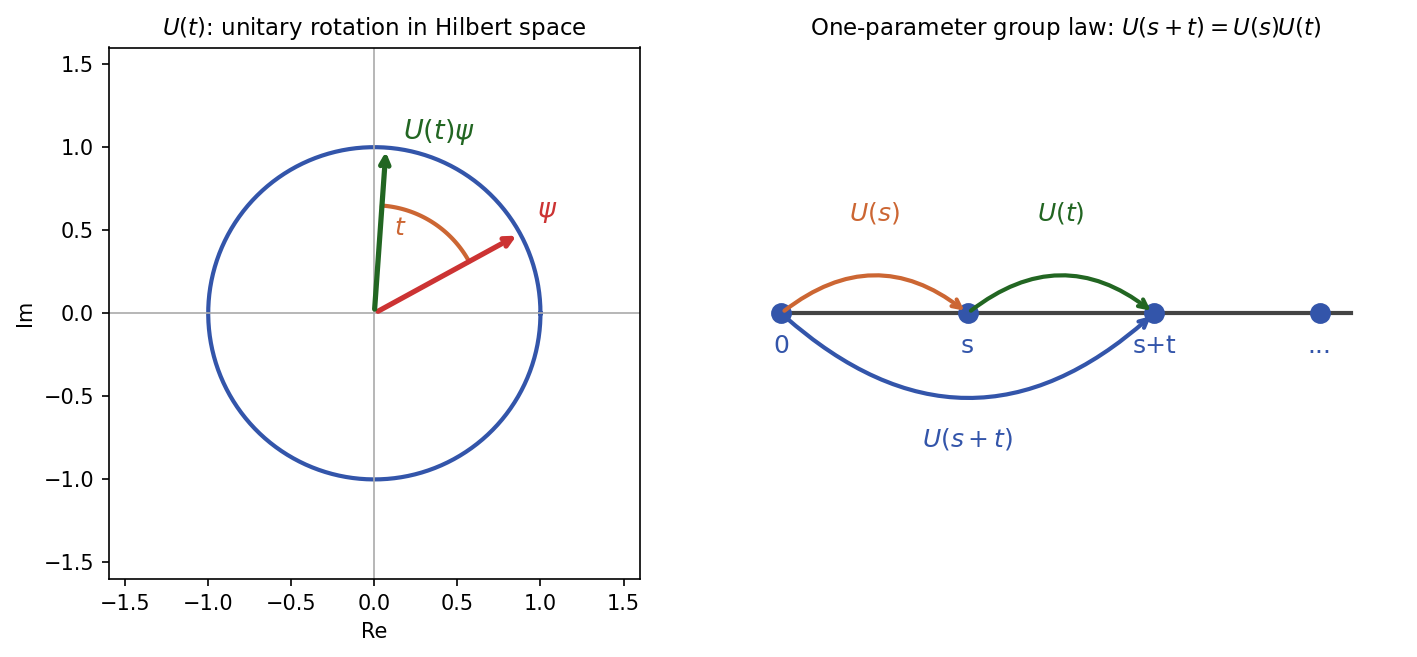
চিত্র ১: বামে \(U(t)\) একটা vector \(\psi\)-কে Hilbert space-এ rotate করছে — time \(t\) বাড়লে কোণ বাড়ে। ডানে group law: \(U(s)\) তারপর \(U(t)\) = \(U(s+t)\) — two steps = one step।
Group Law — Composition Property¶
Group law \(U(s+t) = U(s)U(t)\) হলো একটা fundamental symmetry:
- \(t=0\): \(U(0) = U(0 + 0) = U(0)^2 \Rightarrow U(0) = I\)।
- \(U(-t) = U(t)^{-1} = U(t)^*\)।
- সব \(U(t)\) commute: \(U(s)U(t) = U(t)U(s)\)।
এটা হলো \((\mathbb{R}, +)\) group থেকে \((\mathcal{U}(H), \circ)\) group-এ একটা group homomorphism (গ্রুপ সমরূপতা)।
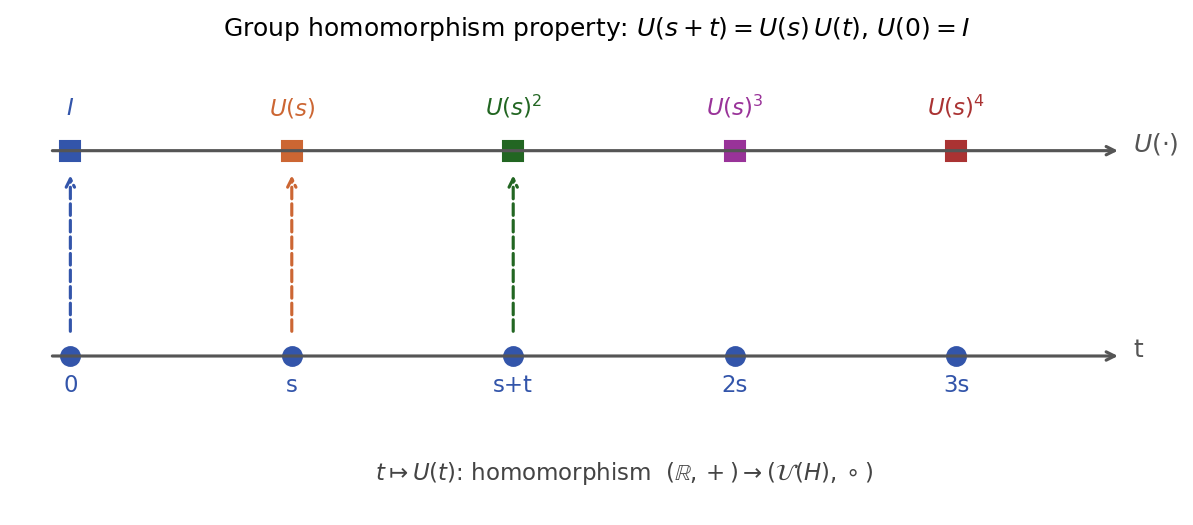
চিত্র ২: Timeline-এ \(0 \to s \to s+t\): প্রথমে \(U(s)\) apply, তারপর \(U(t)\) apply = সরাসরি \(U(s+t)\) apply। এটাই group homomorphism-এর অর্থ।
Strong Continuity — কেন জরুরি?¶
\(t \mapsto U(t)\) pointwise continuous: প্রতিটা \(\psi \in H\)-এর জন্য
এটা strong continuity — uniform continuity (\(\sup_\psi\) over all \(\psi\)) নয়, শুধু প্রতিটা vector-এর জন্য। এই দুর্বল শর্তও যথেষ্ট Stone-এর theorem-এর জন্য।
৩. সংজ্ঞা ও উপপাদ্য (Definitions & Theorems)¶
Generator সংজ্ঞা¶
সংজ্ঞা: Infinitesimal Generator (অনন্তক্ষুদ্র জনক)
\(\{U(t)\}\) strongly-continuous one-parameter unitary group-এর infinitesimal generator (ইনফিনিটেসিমাল জেনারেটর) \(A\) সংজ্ঞায়িত হয়:
Domain (ডোমেইন): \(D(A) = \left\{\psi \in H : \lim_{t \to 0} \frac{U(t)\psi - \psi}{it} \text{ exists in } H\right\}\)।
স্বজ্ঞা: \(A\) হলো \(U(t)\) curve-এর \(t=0\)-এ tangent vector, \(i\) দিয়ে ভাগ করা। Note: factor \(i\) এজন্য আছে যাতে \(A\) self-adjoint হয় (physicist convention: \(U(t) = e^{itA}\) নয়, \(e^{-itH}\) — তাই \(H = A\hbar\))।
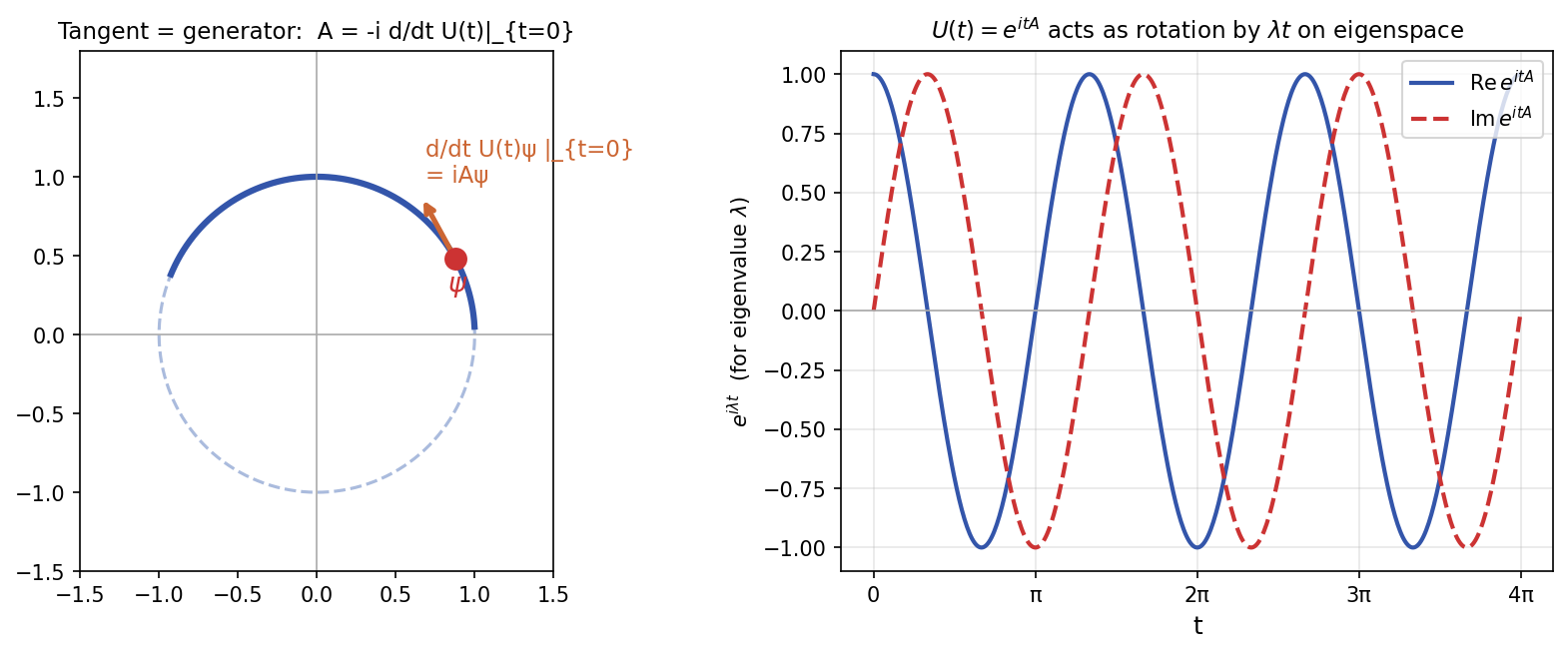
চিত্র ৩: বামে Hilbert space-এ curve \(t \mapsto U(t)\psi\), এবং \(t=0\)-এ tangent = \(iA\psi\)। ডানে eigenspace-এ \(e^{i\lambda t}\) oscillation — generator-এর eigenvalue \(\lambda\)।
Stone's Theorem (মূল উপপাদ্য)¶
উপপাদ্য (Stone's Theorem, 1930 / Sternberg ch. 11)
(প্রথম অর্ধ) ধরো \(A\) একটা self-adjoint operator on \(H\) (possibly unbounded)। তাহলে:
একটা strongly-continuous one-parameter unitary group গঠন করে (যেখানে \(\{E_\lambda\}\) হলো \(A\)-এর spectral measure)। Generator of \(\{U(t)\}\) হলো \(A\) নিজেই।
(দ্বিতীয় অর্ধ — Stone's converse) যদি \(\{U(t)\}\) একটা strongly-continuous one-parameter unitary group হয়, তাহলে exactly একটা self-adjoint operator \(A\) আছে যাতে \(U(t) = e^{itA}\) এবং \(D(A)\) dense in \(H\)।
অর্থ: two-way bijection: self-adjoint operators ↔ strongly-continuous one-parameter unitary groups।
Strong Continuity-র ছবি¶
উপপাদ্য: Strong Continuity Automatic
যদি \(U(t) = e^{itA}\) এবং \(A\) self-adjoint হয়, তাহলে \(\{U(t)\}\) strongly continuous।
প্রমাণ-sketch: \(\|U(t)\psi - \psi\|^2 = \int |e^{it\lambda} - 1|^2\, d\langle E_\lambda \psi, \psi\rangle\)। Dominated convergence (যেহেতু \(|e^{it\lambda}-1|^2 \leq 4\) এবং \(\int d\langle E_\lambda\psi,\psi\rangle = \|\psi\|^2 < \infty\)) দিয়ে পাই \(\to 0\) as \(t \to 0\)।
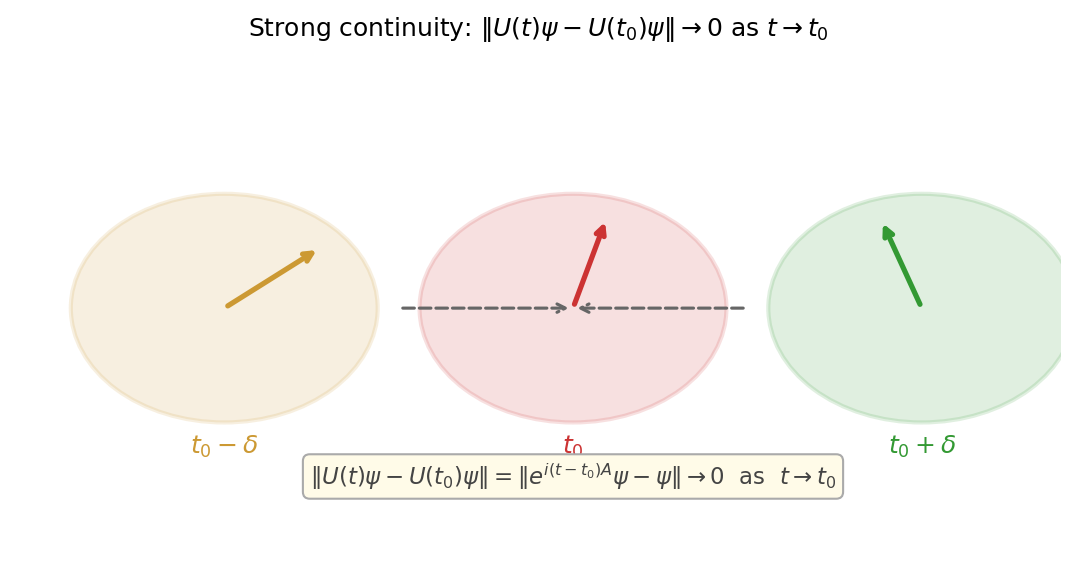
চিত্র ৪: তিনটি time snapshot — \(t_0 - \delta\), \(t_0\), \(t_0 + \delta\)। \(t \to t_0\) হলে \(U(t)\psi \to U(t_0)\psi\) norm-এ (strong continuity)। Unitary হওয়ায় norm সবসময় \(\|\psi\|\)।
Generator-এর Self-Adjointness¶
উপপাদ্য: Generator স্বতঃ Self-Adjoint
\(\{U(t)\}\) strongly-continuous one-parameter unitary group-এর generator \(A\) হলো একটা densely-defined self-adjoint operator (ঘনভাবে সংজ্ঞায়িত স্ব-অভিনয় অপারেটর): \(D(A)\) dense এবং \(A = A^*\)।
প্রমাণ-sketch (Sternberg, ch. 11): Symmetry: ধরো \(\psi, \phi \in D(A)\)। তাহলে:
(কারণ \(U(t)^* = U(-t)\))। Denseness of \(D(A)\): resolvent \(R(z) = \int_0^\infty e^{-zt} U(t)\,dt\) (Re \(z > 0\))-এর image \(D(A)\)-এ dense। \(\square\)
von Neumann-এর Cayley Transform¶
von Neumann (ফন নেউমান) একটি elegant approach দিয়েছিলেন: symmetric operator \(T\)-এর Cayley transform (কেইলি রূপান্তর):
এটা একটা isometry। এবং \(T\) self-adjoint \(\Leftrightarrow\) \(U_T\) unitary (i.e., domain = codomain = \(H\))।
Sternberg (Thm. 11.1.2): Cayley transform একটা bijection: closed symmetric operators ↔ isometries (domain dense)। Self-adjoint ↔ unitary।
৪. উদাহরণ ও Analogy¶
Translation Group on \(L^2(\mathbb{R})\)¶
সবচেয়ে canonical উদাহরণ। \(H = L^2(\mathbb{R})\), \(t \in \mathbb{R}\):
- Unitarity: \(\|U(t)\psi\|^2 = \int |\psi(x-t)|^2\,dx = \|\psi\|^2\)।
- Group law: \((U(s)U(t)\psi)(x) = (U(t)\psi)(x-s) = \psi(x-s-t) = (U(s+t)\psi)(x)\)।
- Generator: \(A = -i\frac{d}{dx}\) (momentum operator, ভরবেগ অপারেটর)।
- Schrödinger: \(i\frac{d}{dt}\psi = A\psi = -i\frac{d}{dx}\psi\) — free particle!
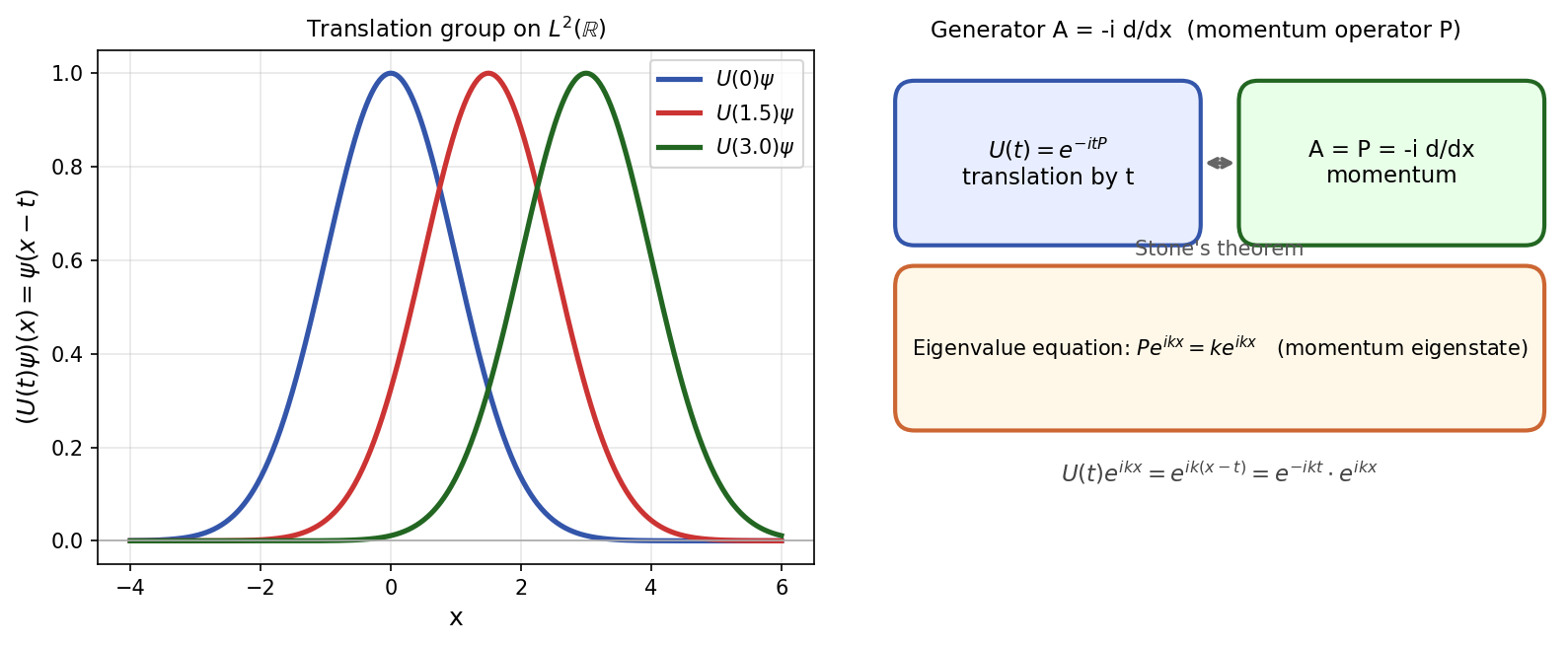
চিত্র ৫: বামে Gaussian wavepacket shift — \(U(t)\psi(x) = \psi(x-t)\) মানে packet ডান দিকে সরছে। ডানে generator \(A = -id/dx\) = momentum operator — Stone-এর bijection।
Quantum Harmonic Oscillator¶
\(H = -\frac{d^2}{dx^2} + x^2\) (harmonic oscillator Hamiltonian, harmonic oscillator হামিলটোনিয়ান)-এর জন্য \(U(t) = e^{-itH}\) হলো quantum harmonic oscillation।
Eigenvalues: \(E_n = 2n+1\) (\(n = 0, 1, 2, \ldots\))।
Energy eigenstate \(\phi_n\)-এ: \(U(t)\phi_n = e^{-i(2n+1)t} \phi_n\)। General state: \(\psi_0 = \sum_n c_n \phi_n \Rightarrow \psi(t) = \sum_n c_n e^{-i(2n+1)t}\phi_n\)।
Analogy: Finite Dimensions¶
\(n \times n\) matrix \(A\) (real symmetric বা Hermitian)-এর জন্য \(e^{itA}\) সহজেই সংজ্ঞায়িত — power series। Stone-এর theorem হলো এই finite-dimensional fact-এর অসীম-মাত্রিক সংস্করণ, কিন্তু unbounded operator-এর জন্য।
৫. Schrödinger Equation ও Conservation Laws¶
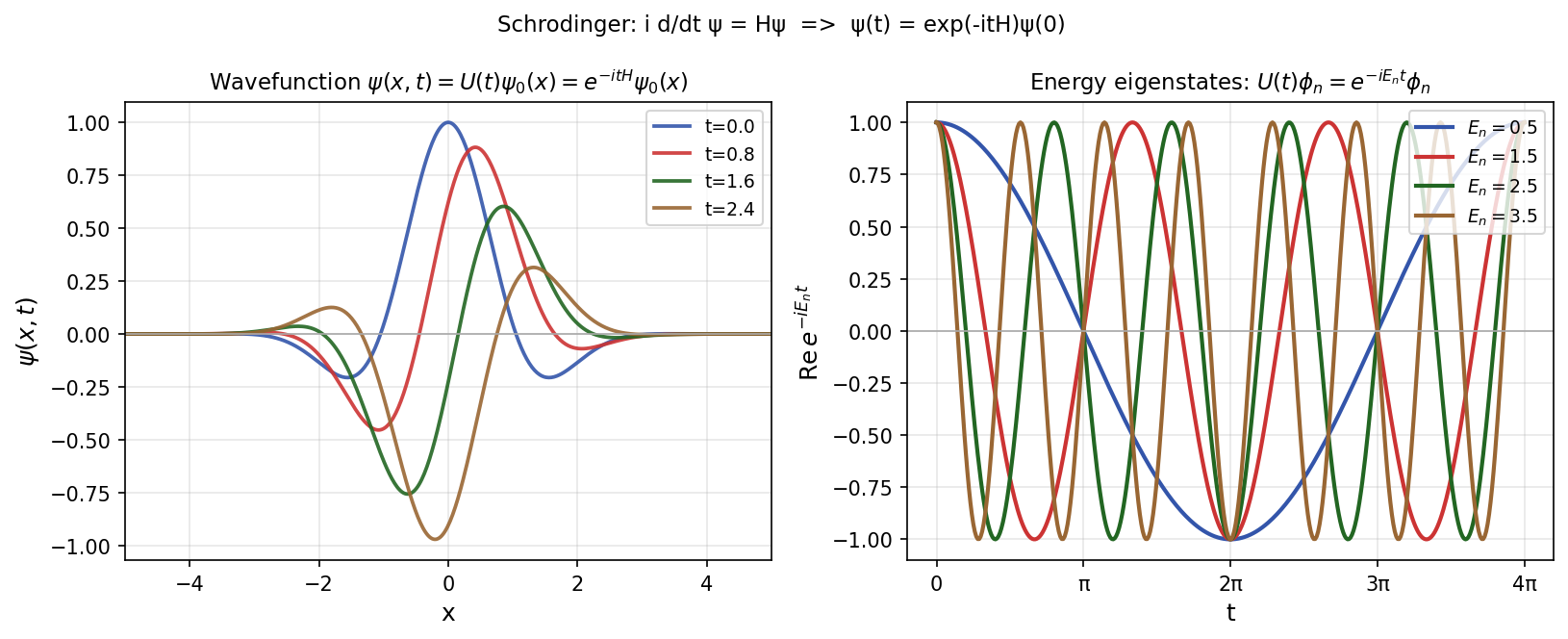
চিত্র ৬: বামে Gaussian wavepacket time evolution \(\psi(x,t)\) — different \(t\)-এ different shapes। ডানে energy eigenstates-এ \(U(t)\) শুধু phase multiply করে: \(U(t)\phi_n = e^{-iE_n t}\phi_n\)।
Schrödinger equation-এর সাথে সংযোগ:
যদি \(\psi_0\in D(H)\) হয়, তবে \(\psi(t)=e^{-itH}\psi_0\) unique strong/classical solution এবং orbit differentiable। Arbitrary \(\psi_0\)-এর জন্য একই formula একটি strongly continuous unitary evolution দেয়, কিন্তু \(H\psi(t)\) বা ordinary derivative defined নাও হতে পারে; তখন mild/weak interpretation লাগে।
Conservation law: Suitable domain invariance ধরে, bounded observable \(B\) যদি \(H\)-এর spectral calculus-এর সঙ্গে strongly commute করে, তবে \(\langle\psi(t),B\psi(t)\rangle\) constant। Unbounded \(B\)-এর ক্ষেত্রে শুধু formal commutator \([B,H]=0\) লেখা যথেষ্ট নয়; common domain ও differentiability condition দরকার।
৬. Cayley Transform এবং Deficiency Spaces¶
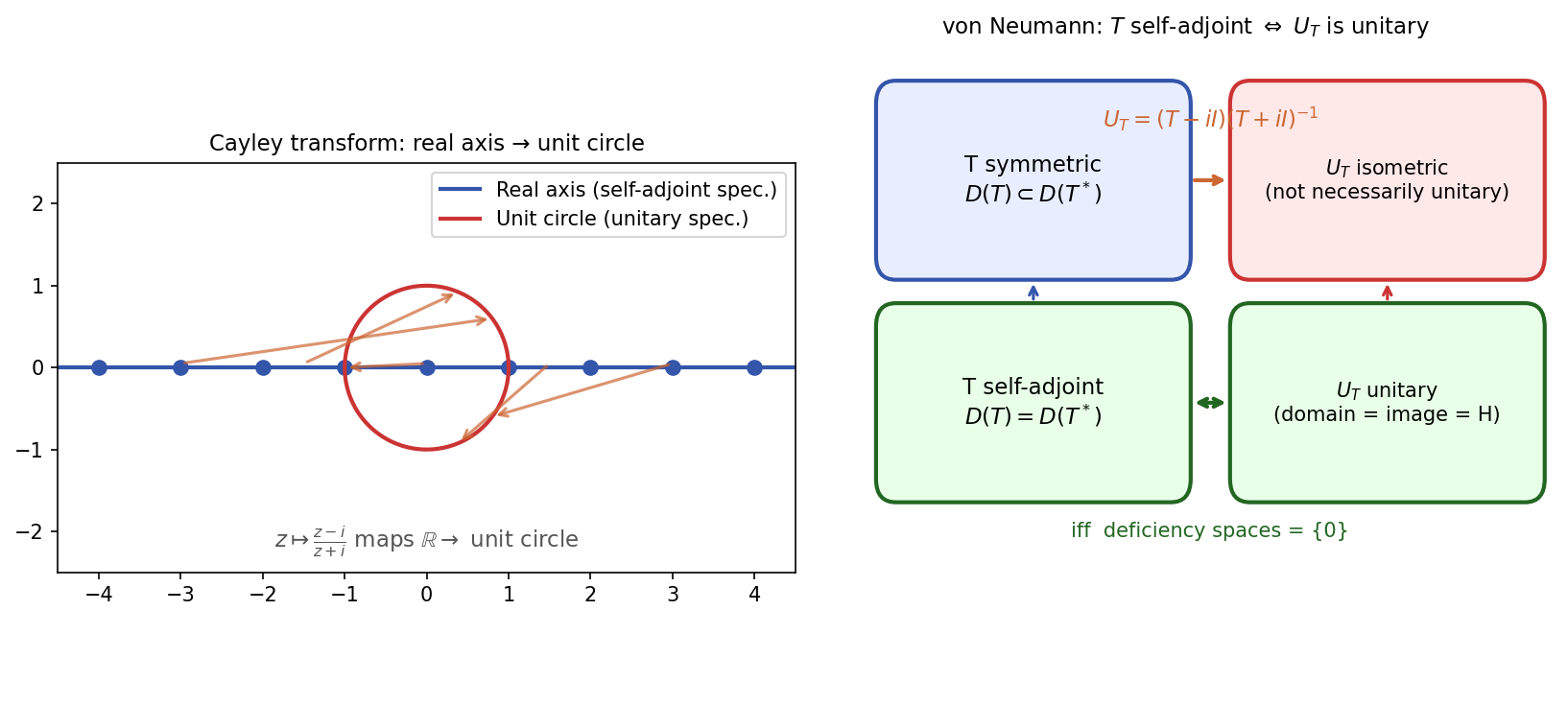
চিত্র ৭: বামে Cayley map \(z \mapsto (z-i)/(z+i)\) — real axis \(\mathbb{R}\) → unit circle \(S^1\) (ঠিক যেমন self-adjoint → unitary)। ডানে von Neumann-এর theorem: \(T\) self-adjoint \(\Leftrightarrow\) \(U_T\) unitary।
Deficiency spaces (ত্রুটি স্পেস): Sternberg (Thm. 11.1.2) অনুযায়ী:
\(T\) self-adjoint \(\Leftrightarrow\) \(H_T^+ = H_T^- = \{0\}\)।
এই deficiency spaces পরিমাপ করে কতটুকু "boundary condition" দরকার \(T\)-কে self-adjoint বানাতে।
Sternberg-এর উদাহরণ (§11.1.1): \(H = L^2([0,1])\), \(T = \frac{1}{i}\frac{d}{dt}\) with \(D(T) = \{x : x' \in L^2, x(0) = x(1) = 0\}\)। এর deficiency spaces each one-dimensional। প্রতিটা boundary condition \(x(1) = e^{i\theta} x(0)\) একটা self-adjoint extension \(A_\theta\) দেয়।
৭. সাধারণ ভুল (Common Mistakes)¶
সাবধান
ভুল ১: \(e^{itA}\) মানে শুধু power series — না। Unbounded \(A\)-এর জন্য power series converge নাও করতে পারে; সঠিক সংজ্ঞা spectral measure দিয়ে।
ভুল ২: Strong continuity = uniform (norm) continuity — না। Unitary group কখনো uniformly continuous হলে তার generator bounded হয় (বিপরীতটা প্রমাণযোগ্য)।
ভুল ৩: Symmetric ⇒ self-adjoint — না। Symmetric মানে \(D(T) \subset D(T^*)\) এবং \(Tx = T^*x\) on \(D(T)\); self-adjoint মানে \(D(T) = D(T^*)\)। পার্থক্য deficiency spaces-এ।
ভুল ৪: Stone-এর theorem real-valued \(A\)-এর জন্য — না। \(A\) self-adjoint হলে real spectrum (eigenvalues), কিন্তু \(A\) নিজে complex Hilbert space-এ কাজ করে।
৮. এক্সারসাইজ (Exercises)¶
সমস্যা ১। \(H = \mathbb{C}^2\), \(A = \begin{pmatrix} 1 & 0 \\ 0 & -1 \end{pmatrix}\) (Hermitian)। \(U(t) = e^{itA}\) explicitly compute করো। কোন initial state \(\psi_0 = \begin{pmatrix} 1 \\ 0 \end{pmatrix}\)-এর জন্য \(U(t)\psi_0\) কেমন?
সমস্যা ২। Translation group \(U(t)\psi(x) = \psi(x-t)\) on \(L^2(\mathbb{R})\)-এ দেখাও যে generator \(A = -i\frac{d}{dx}\) self-adjoint (domain: \(H^1(\mathbb{R})\), Sobolev space)।
সমস্যা ৩। Stone-এর theorem-এর first half prove করো: যদি \(A\) self-adjoint bounded হয়, তাহলে \(U(t) = e^{itA} = \sum_{n=0}^\infty \frac{(itA)^n}{n!}\) strongly continuous one-parameter unitary group।
সমস্যা ৪। ধরো \(U(t)\) একটা strongly continuous one-parameter unitary group এবং \(\psi \in D(A)\) (generator-এর domain)। দেখাও যে \(U(t)\psi \in D(A)\) এবং \(AU(t)\psi = U(t)A\psi\)।
সমস্যা ৫। Cayley transform \(U_T = (T-iI)(T+iI)^{-1}\)-এর জন্য দেখাও যে \(\|U_T x\| = \|x\|\) সব \(x \in \mathrm{im}(T+iI)\)-এর জন্য (isometry property)।
সমস্যা ৬। \(L^2([0,1])\)-এ \(A_\theta = \frac{1}{i}\frac{d}{dt}\) with boundary condition \(x(1) = e^{i\theta}x(0)\) consider করো। এর eigenvalues কী?
সমস্যা ৭। ধরো \(A\) self-adjoint, \(B\) bounded self-adjoint, এবং \([A, B] = AB - BA = 0\) (commute on \(D(A)\))। দেখাও যে \([U(t), B] = 0\) সব \(t\)-এর জন্য।
সমস্যা ৮। Heisenberg picture-এ \(B(t) = U(t)^* B U(t)\)। দেখাও যে \(\frac{d}{dt}B(t) = i[H, B(t)]\) — যেখানে \(H\) হলো generator।
১-নং সমাধান দেখাও
\(A = \begin{pmatrix} 1 & 0 \\ 0 & -1 \end{pmatrix}\)। \(e^{itA} = \begin{pmatrix} e^{it} & 0 \\ 0 & e^{-it} \end{pmatrix}\) (diagonal matrix exponential)।
\(U(t)\psi_0 = \begin{pmatrix} e^{it} & 0 \\ 0 & e^{-it} \end{pmatrix}\begin{pmatrix} 1 \\ 0 \end{pmatrix} = \begin{pmatrix} e^{it} \\ 0 \end{pmatrix}\)।
Norm: \(\|U(t)\psi_0\| = |e^{it}| = 1\) — unitary। Phase oscillates: \(e^{it}\)। Group law: \(U(s)U(t) = \begin{pmatrix} e^{i(s+t)} & 0 \\ 0 & e^{-i(s+t)} \end{pmatrix} = U(s+t)\) ✓।
২-নং সমাধান দেখাও
\(A = -i\frac{d}{dx}\), \(D(A) = H^1(\mathbb{R}) = \{f \in L^2 : f' \in L^2\}\)।
Symmetry: ধরো \(f, g \in D(A)\)। Integration by parts:
(boundary terms vanish কারণ \(f, g \in L^2(\mathbb{R})\) implies \(f, g \to 0\) at \(\pm\infty\))।
Self-adjointness: \(D(A^*) = D(A) = H^1(\mathbb{R})\) — Fourier transform দিয়ে: \(\widehat{Af}(\xi) = \xi\hat{f}(\xi)\), তাই \(A\) corresponds to multiplication by \(\xi\) on \(\hat{L}^2\) — clearly self-adjoint।
৩-নং সমাধান দেখাও
\(A\) bounded হলে power series \(U(t) = \sum_{n=0}^\infty \frac{(itA)^n}{n!}\) converges in operator norm।
Unitarity: \(U(t)^* = e^{-itA^*} = e^{-itA}\) (যেহেতু \(A = A^*\)), এবং \(U(t)U(t)^* = e^{itA}e^{-itA} = I\)।
Group law: \(U(s)U(t) = e^{isA}e^{itA} = e^{i(s+t)A} = U(s+t)\) (\(A\) commutes with itself)।
Strong continuity: \(\|U(t)\psi - \psi\| \leq \sum_{n=1}^\infty \frac{|t|^n \|A\|^n}{n!}\|\psi\| = (e^{|t|\|A\|} - 1)\|\psi\| \to 0\) as \(t \to 0\)।
৪-নং সমাধান দেখাও
\(\psi \in D(A)\)। ধরো \(h \neq 0\):
কারণ \(U(t)\) bounded। \(h \to 0\) নিলে RHS \(\to U(t)(A\psi)\) (strong continuity of \(U(t)\) and \(\psi \in D(A)\))। তাই \(U(t)\psi \in D(A)\) এবং \(AU(t)\psi = U(t)A\psi\)।
৫-নং সমাধান দেখাও
ধরো \(y = (T+iI)x \in \mathrm{im}(T+iI)\)। Sternberg (11.1) এর calculation:
(middle terms cancel কারণ \(T\) symmetric, তাই \(\langle Tx, ix\rangle = i\|Tx\|^2\) real নয়... actually: \(\langle Tx, ix\rangle + \langle ix, Tx\rangle = i\langle Tx, x\rangle - i\langle x, Tx\rangle = i\langle Tx, x\rangle - i\overline{\langle Tx, x\rangle} = 2\,\mathrm{Im}\langle Tx, x\rangle\)। আর \(T\) symmetric হলে \(\langle Tx, x\rangle \in \mathbb{R}\), তাই এই term = 0।)
তাই: \(\|U_T y\|^2 = \|(T-iI)x\|^2 = \|Tx\|^2 + \|x\|^2 = \|(T+iI)x\|^2 = \|y\|^2\)।
৬-নং সমাধান দেখাও
\(A_\theta \phi = \lambda \phi\) মানে \(\frac{1}{i}\phi'(t) = \lambda\phi(t)\), তাই \(\phi(t) = Ce^{i\lambda t}\)।
Boundary condition \(\phi(1) = e^{i\theta}\phi(0)\):
Eigenvalues: \(\lambda_n = \theta + 2\pi n\) (\(n \in \mathbb{Z}\))। Corresponding eigenfunctions: \(\phi_n(t) = e^{i(\theta + 2\pi n)t}\)।
৭-নং সমাধান দেখাও
\([A, B] = 0\) on \(D(A)\)। \(U(t) = e^{itA}\), \(B\) bounded।
ধরো \(\psi \in D(A)\)। \(\frac{d}{dt}(U(t)BU(-t)\psi) = U(t)[iA, B]U(-t)\psi = 0\) (কারণ \([A,B]=0\))।
তাই \(U(t)BU(-t)\psi = B\psi\) (constant in \(t\)), অর্থাৎ \(U(t)B = BU(t)\) on \(D(A)\)।
\(D(A)\) dense হওয়ায় এবং \(U(t), B\) bounded হওয়ায়: \(U(t)B = BU(t)\) on all of \(H\)।
৮-নং সমাধান দেখাও
\(B(t) = U(-t)BU(t) = e^{-itH}Be^{itH}\)।
Wait — standard convention: \(\frac{d}{dt}B(t) = i[H, B(t)]\)।
আমাদের: \(-iHB + iBH = i(BH - HB) = -i[H,B] = i[B,H]\)। তাই \(\frac{d}{dt}B(t) = i[B(t), H] = -i[H, B(t)]\)। (Convention-এর ব্যাপার — physicists লেখে \(\frac{d}{dt}B(t) = \frac{i}{\hbar}[H, B(t)]\)।)
৯. সারসংক্ষেপ ও Checklist¶
- [ ] One-parameter unitary group: \(U(s+t) = U(s)U(t)\), \(U(0) = I\), strongly continuous, unitary।
- [ ] Generator: \(A\psi = \lim_{t\to 0} \frac{U(t)\psi - \psi}{it}\); densely defined, self-adjoint।
- [ ] Stone's theorem: bijection: self-adjoint \(A\) ↔ strongly-continuous one-parameter unitary group \(\{e^{itA}\}\)।
- [ ] Spectral form: \(U(t) = \int e^{it\lambda}\,dE_\lambda\) — spectral measure দিয়ে।
- [ ] Schrödinger: \(i\frac{d}{dt}\psi = H\psi \Rightarrow \psi(t) = e^{-itH}\psi(0) = U(t)\psi(0)\)।
- [ ] Translation group: \(U(t)\psi(x) = \psi(x-t)\); generator = \(-i\frac{d}{dx}\) (momentum)।
- [ ] Cayley transform: \(U_T = (T-iI)(T+iI)^{-1}\); \(T\) self-adjoint \(\Leftrightarrow\) \(U_T\) unitary।
- [ ] Conservation: \([H, B] = 0 \Leftrightarrow\) \(B\) conserved under time evolution \(e^{-itH}\)।
- [ ] Symmetric vs self-adjoint: পার্থক্য deficiency spaces \(H_T^\pm\) — boundary conditions-এ।
➡️ পরের অধ্যায়: 7.7 — Scattering Theory (এক ঝলক) — two self-adjoint operators \(H_0\) ও \(H\) (free ও interacting Hamiltonian)-এর সম্পর্ক; wave operators, S-matrix, এবং asymptotic completeness — quantum mechanics-এ particle collision-এর mathematical framework।